Reef 'at risk in climate change'
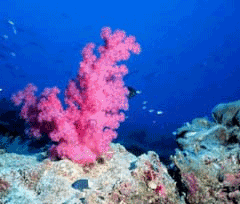
Australian scientists who contributed to the latest global greenhouse study say the Great Barrier Reef is one of the nation's great assets most at risk under climate change.
The two main threats facing the reef are rising sea temperatures, which cause mass coral die-offs due to bleaching, and the gradual acidifying of the oceans from CO2 in the atmosphere, which prevents corals from forming their limestone skeletons.
Other impacts such as increased cyclone intensity, drought and flood runoff from the land and coral disease outbreaks will play a lesser but nonetheless important role, they said.
Professor Terry Hughes and Professor Ove Hoegh-Guldberg of the Australian Research Council Centre for Excellence for Coral Reef Studies (CoECRS) provided expert advice to the Intergovernmental Panel on Climate Change (IPCC) which has released its latest report in Brussels today.
They contributed to sections dealing with observed changes to the Earth's natural systems due to climate change and a detailed analysis of the likely outlook for Australia and New Zealand.
The report says coral bleaching has become increasingly common in the ocean's corals since the 1980s, with the worst event – in 1998 – killing 16 per cent of the world's corals. There has also been an upsurge in disease among reef species and a tendency for seaweeds to replace corals. If corals become rare, the report adds, many other reef organisms will also become vulnerable.
The IPCC report also notes the oceans are becoming more acidic: “Evidence indicates that the average pH of surface sea water has fallen by 0.1 units in the last 200 years. This represents a 30% increase in the concentration of hydrogen ions in the surface oceans,” it says.
“Based on current trends, sea temperatures at the northern tip of the GBR today are likely to apply to the southern parts of the reef by 2050”, Professor Hoegh-Guldberg said.
Temperatures only a degree above the current summer average can cause mass bleaching of corals, and if they persist at 2-3 degrees warmer the corals die. There have been eight such events in Australia since 1979.
In 1998, 42 per cent of the reef's total area was hit by varying levels of bleaching. In 2002, 54 per cent of the reef was affected by rising water temperatures.
A further concern has been the dramatic emergence of coral diseases, some of which have increased in observed area by 500 per cent in the past decade.
The greatest concern, Professor Hughes and Professor Hoegh-Guldberg said, was ocean acidification. The oceans have so far absorbed over a third of all the CO2 emitted by human activity into the atmosphere, making the ocean slightly more acidic and significantly reducing the concentration of carbonate ions. These ions are used by corals to build the limestone skeletons of coral reefs.
The ability of corals to form their limestone skeletons declines with rising acidity – and at a certain point corals can longer form skeletons. This tipping-point will be reached if atmospheric concentrations of CO2 rise from 375 parts per million today to over 500ppm. This concentration of CO2 is at the lower end of the scenarios projected for the end of the century.
“Even under a moderate warming scenario of two degrees by 2100, corals on the GBR are very likely to be exposed to summer temperatures that regularly exceed the thermal thresholds seen in the last 20 years,” the researchers said.
“This means bleaching is likely to be an annual event on at least parts of the GBR, possibly by 2030, and almost certainly by 2050. Since it takes 10-50 years for a reef to recover from a severe bleaching event, these projections indicate a significant part of our corals could be replaced by seaweeds, unless the corals can evolve incredibly quickly.”
A big unknown is whether corals have the genetic ability to evolve quickly enough to cope with such rapid changes. Given the speed of the changes, this seems at best uncertain. Impacts on reef biodiversity, fishing and tourism are therefore likely, they say. Tourism associated with the GBR generated over US$4.5 billion in 2004-5 and provided around 63,000 full-time equivalent jobs. It is the largest employer in many coastal Queensland's towns.
Protecting fish populations can aid reef recovery after a bleaching event.
“Scientists at the ARC Centre for Excellence for Coral Reef Studies showed earlier this year that reefs can recover three times faster if fish populations are left intact,” they said. “These measures will have a big influence on reef survival while the world rises to the challenge of getting emissions under control.”
Maximizing the GBR's resilience to climate change also underscores the critical importance of management measures to protect the reef by reducing other man-made stresses on its coral, such as the Reef Water Quality Protection Plan and the Green Zone no-fishing policy introduced by the Great Barrier Reef Marine Park Authority, Professor Hughes and Professor Hoegh-Guldberg said.
Source: University of Queensland


