Cells selectively absorb short nanotubes
Mar 30, 2007
Cells selectively absorb short nanotubes
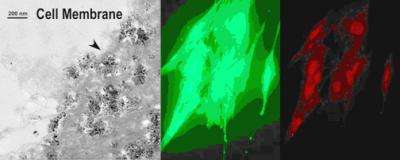
Nanotube length threshold: NIST experiments using human lung cells demonstrate that DNA-wrapped single-walled carbon nanotubes longer than about 200 nanometers are excluded from cells, while shorter lengths are able to penetrate the cell interior (dark lines in the fluorescence image above). Credit: NIST

DNA-wrapped single-walled carbon nanotubes (SWCNTs) shorter than about 200 nanometers readily enter into human lung cells and so may pose an increased risk to health, according to scientists at the National Institute of Standards and Technology. The results of their laboratory studies appear in an upcoming issue of Advanced Materials.

Eyed for uses ranging from electronic displays to fuel cells to water filtration, SWCNTs are tiny cylinders—essentially single-sheet rolls of carbon atoms. They are many times stronger than steel and possess superlative thermal, optical and electronic properties, but safety and biocompatibility remain an open question.

"Published data citing in vitro (outside the body) toxicity are particularly inconsistent and widely disputed," writes biomaterials scientist Matthew Becker and his NIST colleagues. Public concerns surrounding the environmental, health and safety impacts of SWCNTs could derail efforts to fast track the development of nanotubes for advanced technology applications. A significant hurdle in outlining the parameters contributing to nanotube toxicity is to prepare well-defined and characterized nanotube samples, as they typically contain a distribution of lengths, diameters, twists and impurities.

The team chose to isolate the effects of nanotube length. They first adsorbed short DNA molecules onto the nanotubes because this renders them soluble in water and allows them to be sorted and separated by length. The researchers then exposed human lung fibroblasts to solutions containing unsorted nanotubes. Regardless of the concentration levels, the cells did not absorb between about one-fourth and one-third of the SWCNTs in the solutions. Further examination of the results revealed that only short nanotubes made it into the cellular interior.

In the next phase of the research, the team exposed the cells to sorted nanotubes of controlled length. They found that tubes longer than about 200 nanometers were excluded from the cells and remained in solution. Cells exposed to the longer nanotube solutions did not undergo a decrease in metabolic activity, but cells exposed to nanotubes below that threshold absorbed them and, depending on the concentration level, died or showed other signs of toxicity. "Our results demonstrate that cellular uptake in these lung cells depends significantly on the length of the nanotubes," Becker explains. "This is the first of many steps in the critical goal of reducing health risk by de novo engineering of the nanotubes themselves."

Citation: M.L. Becker, J.A. Fagan, N.D. Gallant, B.J. Bauer, V. Bajpai, E.K. Hobbie, S.H. Lacerda, K. B. Migler and J.P. Jakupciak. Length-dependent uptake of DNA-wrapped single-walled carbon nanotubes. Advanced Materials, published on-line : 20 March 2007.

Source: National Institute of Standards and Technology

Explore further: Hybrid material as gold-leaf substitute

add to favorites email to friend print save as pdf

Related Stories

How nanotechnology could keep your heart healthy

May 17, 2013

Since the heart is such a delicate and critical organ, clinicians usually opt not to intervene with the dead cells that remain after a heart attack or cardiac disease. "But we think that all heart attacks deserve some kind ...

Diamonds, nanotubes find common ground in graphene

May 28, 2013

What may be the ultimate heat sink is only possible because of yet another astounding capability of graphene. The one-atom-thick form of carbon can act as a go-between that allows vertically aligned carbon ...

As fuel cells evolve, a role emerges for palladium

Mar 18, 2013

(Phys.org) —Researchers at Yale University have taken another step toward the development of low-temperature, lower-cost alkaline fuel cells, which are battery-like devices that convert oxygen and hydrogen ...

Recommended for you

Hybrid material as gold-leaf substitute

Jun 18, 2013

(Phys.org) —A team of researchers headed by Professor Raffaele Mezzenga has created a hybrid material out of gold and milk proteins that looks like a wafer-thin gold leaf. Thanks to its properties, it could ...

Antioxidant with a long shelf life

Jun 17, 2013

(Phys.org) —Scientists from ETH Zurich have developed a nanomaterial that protects other molecules from oxidation. Unlike many such active substances in the past, the ETH-Zurich researchers' antioxidant ...

Fast pollutant degradation by nanosheets

Jun 17, 2013

(Phys.org) —Waste from textile and paint industries often contains organic dyes such as methylene blue as pollutants. Photocatalysis is an efficient means of reducing such pollution, and molybdenum trioxide ...

Unzipped nanotubes unlock potential for batteries

Jun 13, 2013

(Phys.org) —Researchers at Rice University have come up with a new way to boost the efficiency of the ubiquitous lithium ion (LI) battery by employing ribbons of graphene that start as carbon nanotubes.

Nanoparticle opens the door to clean-energy alternatives

Jun 13, 2013

(Phys.org) —Cheaper clean-energy technologies could be made possible thanks to a new discovery. Research team members led by Raymond Schaak, a professor of chemistry at Penn State University, have found ...

User comments : 0

More news stories

Sound waves precisely position nanowires

(Phys.org) —The smaller components become, the more difficult it is to create patterns in an economical and reproducible way, according to an interdisciplinary team of Penn State researchers who, using ...

An environmentally friendly battery made from wood

Taking inspiration from trees, scientists have developed a battery made from a sliver of wood coated with tin that shows promise for becoming a tiny, long-lasting, efficient and environmentally friendly energy ...

Hybrid nanostructures: Getting to the core

Material scientists expect the new multifunctional properties of hybrid nanostructures will transform the development of high-performance devices, including batteries, high-sensitivity sensors and solar cells. ...

Sweet solutions for detecting disease

Based at the Institute of Chemistry in the Slovak Academy of Sciences, Ján Tkáč's research combines glycomics – the study of sugars in organisms – with biochip sensors based on nanoparticles and nanotubes. ...

US doctors' group labels obesity a disease

(HealthDay)—In an effort to focus greater attention on the weight-gain epidemic plaguing the United States, the American Medical Association has now classified obesity as a disease.

Sexually transmitted HPV declines in US teens

The number of US girls with the sexually transmitted disease HPV has dropped by about half even though relatively few youths are getting the vaccine, research showed on Wednesday.