No Carrier Necessary: This Drug Delivers Itself
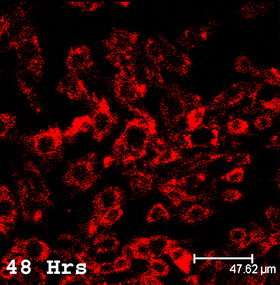
The problem of efficiently delivering drugs, especially those that are hydrophobic or water-repellant, to tumors or other disease sites has long challenged scientists to develop innovative delivery systems that keep these drugs intact until reaching their targets.
Now scientists in the University at Buffalo's Institute for Lasers, Photonics and Biophotonics and Roswell Park Cancer Institute have developed an innovative solution in which the delivery system is the drug itself.
They describe for the first time in Molecular Pharmaceutics a drug delivery system that consists of nanocrystals of a hydrophobic drug.
The system involves the use of nanocrystals measuring about 100 nanometers of pure HPPH, (2-devinyl-2-(1'-hexyloxyethyl) pyropheophorbide), a photosensitizer currently in Phase I/II human clinical trials at RPCI for treating various types of cancer.
The UB researchers found that the nanocrystals of HPPH were taken up by tumors in vivo, with efficacy comparable to conventional, surfactant-based delivery systems.
A patent has been filed on this work.
"In this case, the drug itself acts as its own carrier," said Haridas Pudavar, Ph.D., UB research assistant professor of chemistry and a co-author.
The nanocrystals present a major advantage over methods of delivery involving other carriers, according to Paras Prasad, Ph.D., SUNY Distinguished Professor in the Department of Chemistry in UB's College of Arts and Sciences, executive director of the institute and a co-author.
Because other delivery systems, especially those containing surfactants, commonly used with HPPH and many other drugs, may add to the toxicity in the body, they have been considered imperfect solutions.
"Unlike formulations that require separate delivery systems, once this drug is approved, no additional approvals will be needed," said Prasad.
"Our published data in animal models demonstrate no difference in drug activity with the nanocrystal formulation," said Ravindra Pandey, Ph.D., Distinguished Professor of Biophysical Sciences at RPCI and a co-author on the paper.
"This is a case where the easiest formulation works the best," added Indrajit Roy, Ph.D., UB research assistant professor of chemistry and another co-author.
The researchers found that because HPPH is amphiphillic, i.e., partially soluble in water and oil, nanocrystals of it will self-assemble, that is, in solution the molecules aggregate, but not into such big clusters that they settle to the bottom.
"It's a controlled formation of a colloidally stable suspension of nanosized crystals," explained Tymish Ohulchanskyy, Ph.D., UB senior research scientist and a co-author.
The researchers originally were investigating nanocrystals as a delivery method for hydrophobic dyes in bioimaging applications, another promising use for nanocrystals that they continue to pursue.
Further in vivo studies with HPPH nanocrystals are being conducted by scientists at UB and RPCI, including Pandey and Allan R. Oseroff, M.D., Ph.D., chair of the department of dermatology at RPCI and in UB's School of Medicine and Biomedical Sciences.
The UB/RPCI team is exploring the use of the same technique for delivering other hydrophobic drugs, including those used in chemotherapy.
Additional co-authors on the paper are Koichi Baba, Ph.D., former postdoctoral research associate in the UB Department of Chemistry, and Yihui Chen, Ph.D., postdoctoral research associate at RPCI.
The nanocrystal research was supported by the National Institutes of Health, the John R. Oishei Foundation and UB's New York State Center of Excellence in Bioinformatics and Life Sciences with additional support from RPCI.
In related work, the UB researchers have achieved improved depth penetration of HPPH using two-photon photodynamic therapy, research that recently was published in the Journal of the American Chemical Society.
Source: University at Buffalo


