IMEC reports robust technology to functionalize nanoparticles for biomedical applications
Feb 21, 2007
IMEC reports robust technology to functionalize nanoparticles for biomedical applications
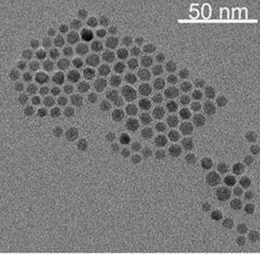
Electron microscopy of the magnetic nanoparticles. Credit: IMEC

IMEC, an independent Belgian research center, developed a generic and versatile method to synthesize stable, biocompatible magnetic nanoparticles. By tuning the endgroups, the functionalized nanoparticles can be used for a wide variety of biomedical applications, such as accurate drug delivery, improved diagnostics and targeted cancer therapy.

The interest for using functionalized magnetic nanoparticles for biomedical and bioengineering applications is rapidly increasing. They can be widely used for in-vitro as well as in-vivo applications such as magnetic biosensing, cell separation, contrast enhancement in magnetic resonance imaging, tissue repair, hyperthermia treatment and accurate drug delivery. To apply magnetic nanoparticles in these fields, the size, shape and (bio)chemical coating of the particles need to be accurately controlled, the thermal and chemical stability needs to be retained and the magnetization values must be high.

IMEC realized a first ever reported robust technology for functionalized magnetic nanoparticles meeting the stringent biomedical characteristics by using a hydrophobic surfactant to passivate the surface. To make them compatible with biological environments, the nanoparticles are made water-soluble. The latter is done by a novel self-assembly procedure in which the hydrophobic surface ligands are replaced by silanes bearing a choice of three different endgroups (amino, carboxylic acid or poly(ethylene glycol)). As a result, the magnetic nanoparticles achieve highly stable and water-dispersible properties. The silane molecules even form a protective layer against mild acid and alkaline environments. The possibility to use three different endgroups makes the nanoparticles suitable to interact with various biological particles such as proteins, DNA or cells.

IMEC will be investigating if the functionalized magnetic nanoparticles can enhance the contrast of magnetic resonance imaging by magnetically tagging cells after bringing functionalized magnetic nanoparticles in the blood stream. IMEC also researches the use of the nanoparticles for cancer diagnostic and hyperthermia treatment. In this technique, a changing magnetic field is sent through the tagged cancer cells, which overheats the cell and thus allows localized treatment of the cancer tumor. Furthermore IMEC currently investigates, in collaboration with the VIB department of Molecular and Developmental Genetics at KULeuven, the possibilities to apply these nanoparticles as purification agents in cellular proteomics.

"Biomedical electronics is one of the fastest growing markets. Technologies for biomedical electronics are developed at the crossroads of microelectronics, nanotechnology and biotechnology and therefore form an interesting research domain for IMEC;" said Gustaaf Borghs, IMEC fellow. "By complementing our basic expertise in micro- and nanoelectronic engineering with expertise in the fields of medicine, chemistry and biology, IMEC is rapidly becoming an interesting partner for the medical and pharmaceutical industry."

Source: IMEC

Explore further: Researchers perform fastest measurements ever made of ion channel proteins

add to favorites email to friend print save as pdf

Related Stories

US Navy launches unmanned aircraft from carrier

23 minutes ago

The U.S. Navy for the first time Tuesday launched an unmanned aircraft the size of a fighter jet from a warship in the Atlantic Ocean, as it wades deeper into America's drone program amid growing concerns ...

Saudi Arabia looks to NREL for solar monitoring expertise

31 minutes ago

Saudi Arabia is planning to move aggressively into renewable energy, with plans to install more solar and wind power in the next 20 years than the rest of the world has installed to date. The Kingdom of Saudi Arabia is working ...

The brain as a model for future supercomputers

1 hour ago

(Phys.org) —The brain's repute took a big hit in 1997 when an IBM supercomputer defeated world chess champion Gary Kasparov in a match reported around the world. But in the second round, the brain is back.

Realtime map shows Wikipedia changes worldwide

1 hour ago

(Phys.org) —The show of shows: A realtime map that you can watch, and watch, which displays where in the word people are editing articles for Wikipedia. We are almost tempted to issue a warning here that ...

Recommended for you

Advance in nanotech gene sequencing technique

15 hours ago

(Phys.org) —The allure of personalized medicine has made new, more efficient ways of sequencing genes a top research priority. One promising technique involves reading DNA bases using changes in electrical ...

How nanotechnology could keep your heart healthy

May 17, 2013

Since the heart is such a delicate and critical organ, clinicians usually opt not to intervene with the dead cells that remain after a heart attack or cardiac disease. "But we think that all heart attacks deserve some kind ...

User comments : 0

More news stories

Engineers' nanoantennas improve infrared sensing

(Phys.org) —A team of University of Pennsylvania engineers has used a pattern of nanoantennas to develop a new way of turning infrared light into mechanical action, opening the door to more sensitive infrared ...

Advance in nanotech gene sequencing technique

(Phys.org) —The allure of personalized medicine has made new, more efficient ways of sequencing genes a top research priority. One promising technique involves reading DNA bases using changes in electrical ...

New immune system discovered

(Medical Xpress)—A research team, led by Jeremy Barr, a biology post-doctoral fellow, unveils a new immune system that protects humans and animals from infection.

Lab sets a new record for creating heralded photons

(Phys.org) —Entanglement, by general consensus of physicists, is the weirdest part of quantum science. To say that two particles, A and B, are entangled means that they are actually two parts of an inseparable ...

Protein study suggests drug side effects are inevitable

A new study of both computer-created and natural proteins suggests that the number of unique pockets – sites where small molecule pharmaceutical compounds can bind to proteins – is surprisingly small, meaning drug side ...