The mysterious case of Columbus's silver ore
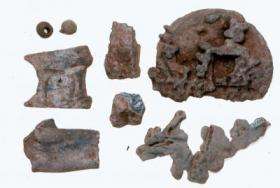
Silver-bearing ore found at the settlement founded by Christopher Columbus's second expedition was not mined in the Americas, new research reveals. The ore that researchers excavated from the settlement, La Isabela, came from Spain, said Alyson Thibodeau, who analyzed the ores.
"What appeared to be the earliest evidence of European finds of precious metals in the New World turned out not to be that at all," said David J. Killick. "It's a very different story."
The explorers brought the Spanish ore to La Isabela to use for comparison when assaying the new ores they expected to find, the researchers surmise. The expedition's purpose was discovering precious metals.
But by 1497, La Isabela's remaining settlers, having found no gold or silver, were desperate to salvage something of value from the failed settlement. They were reduced to extracting silver from the galena they brought from Spain, the researchers said.
"This part of the story of Columbus's failed settlement is one that couldn't be found in the historical documents," said Thibodeau, a geosciences graduate student at The University of Arizona in Tucson. "We could never have figured this out without applying the techniques of physical sciences to the archaeological artifacts."
Thibodeau, Killick, a UA associate professor of anthropology, and their colleagues will publish their article, "The Strange Case of the Earliest Silver Extraction by European Colonists in the New World," in the early online edition of the Proceedings of the National Academy of Sciences during the week of February 19.
The other authors are UA's Joaquin Ruiz, John T. Chesley and Ward Lyman; Kathleen Deagan of the University of Florida in Gainesville; and José M. Cruxent (deceased). The National Science Foundation, Direccion Nacional de Parques de la Republica Dominicana, the National Endowment for the Humanities, the National Geographic Society and the Keck Foundation helped fund the research.
La Isabela, the first European town in the New World, was established by Columbus's second expedition in 1494 on the northern coast of the present Dominican Republic.
The approximately 1500 members of the expedition expected to make their fortunes by finding precious metals but instead found hurricanes, hunger and disease. Columbus was recalled to Spain in 1496, and the few hundred remaining inhabitants abandoned the town in 1498.
Archaeologists excavating the site in the late 1980s and early 1990s found about 100 pounds of galena, a silver-bearing lead ore, and more than 200 pounds of metallurgical slag. The ore and slag were associated with a small furnace near the alhóndiga, a building for the storage and protection of royal property.
Archaeologist Deagan sent pieces of the material to archaeometallurgist Killick for analysis.
The slag turned out to be lead silicate -- the end product of an improvised smelting process, Killick said, adding "Lead silicate is good for nothing." Other smelting processes used at the time could recapture the ore's lead so it could be used for musket balls and as cladding for ships.
"Why waste the lead?" Killick said. "Normally, they would smelt the galena to lead."
Killick and graduate student Ward Lyman examined the slag under a microscope and saw specks of silver, suggesting that Columbus's followers were trying to extract silver from the galena by removing all the lead.
"We thought, 'Fantastic!' The first evidence of Europeans prospecting for silver in the New World."
By reviewing the accounts of Columbus’s second voyage, Thibodeau found the expedition had visited islands where geologists now know galena occurs.
It was puzzling that the documents made no mention of finding such ore, Killick said. Maybe it didn't seem to be enough metal to mention or maybe some members of the expedition were trying to hide the discovery.
Thibodeau then used lead isotope analysis to determine where La Isabela's galena originated. The ratio of the different forms, or isotopes, of lead provides a kind of fingerprint that can indicate the source of a rock.
"We're looking at something about the rock's chemistry and using that to tell us where it came from," she said. "It's like Antiques Roadshow where the appraiser looks at some characteristic of an antique and says, 'This was made by so-and-so at such-and-such a time.'"
Figuring out that the galena came from Spain led to the question, why bring ore? The documents report that the expedition also brought lead.
By contacting an expert in medieval chemistry, the scientists learned that a common practice of the time was mixing galena with powdered ores suspected of having gold or silver. The process provided an assay of the gold or silver in the newly discovered hunk of ore by comparing it with galena containing a known, small quantity of silver.
Given that the expedition purpose was discovering new sources of precious metals, it makes sense that the members toted along materials to assess their discoveries.
"It was a nice detective story," Killick said. "We think we've solved this one."
But there are more archaeological puzzles out there, Thibodeau said.
"Archaeology tells us what might be an interesting question to ask -- and the physical sciences gives us a way to answer the question," Thibodeau said.
Source: University of Arizona


