February 14, 2007 feature
New Organic Gold-Nanoparticle Memory Device
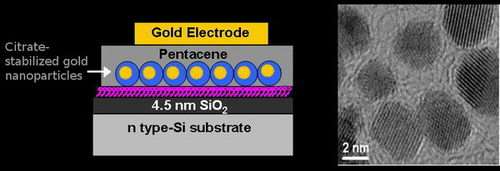
Researchers have developed a new memory device that uses gold nanoparticles and the organic semiconducting compound pentacene. This novel pairing is a key step forward in the drive to develop organic "plastic" memory devices, which can be considerably cheaper and more versatile than the conventional silicon-based devices used in computers, flash drives, and other applications.
“The ability of gold nanoparticles to self-assemble into ordered arrays gives them great potential in silicon memory applications, as research has shown. We took the next step by combining them with pentacene to form a new organic memory system,” said Wei Lin Leong, a materials scientist at Nanyang Technological University, in Singapore, to PhysOrg.com. Leong is the lead author of the paper describing the device, which is published in the January 23 online edition of Applied Physics Letters.
The device has a layered structure. From the top down, it consists of a gold electrode, the pentacene layer, the gold nanoparticles, a layer of a compound used to help the nanoparticles adhere to the bottom layer, and then the bottom layer: a silicon/silicon dioxide substrate that forms the second electrode.
The gold nanoparticles act as the device's charge-storage elements, which are the key to its ability to store information. They are arranged in a layer one nanoparticle deep and have diameters ranging from three to five nanometers. To stabilize them, the researchers embedded them in citrate, a type of citric acid, like peanuts in peanut brittle. The pentacene forms the device's semiconductor layer.
The researchers tested this structure's ability to act as a memory device by measuring how it reacted to various applied voltages. As a control, they created a similar structure that did not contain a gold-nanoparticle layer.
The measurements from the control sample indicated that it did not retain any charge. But the measurements from the nanoparticle-containing device indicated just the opposite: Under a negative voltage, pockets of positive charge called “holes” became injected into the pentacene layer and were then forced down and trapped within the nanoparticle layer. Applying a positive voltage flushed out the holes.
“This approach of using citrate-stabilized gold nanoparticles as charge 'nanotraps,' by virtue of its simplicity in design and processing, may help lead to memory devices and circuits that can be integrated into low-cost, plastic electronics applications,” said Leong. “In fact, this work is part of a wider initiative called Polymer and Molecular Electronics and Devices (PMED), which is a collaboration between the Agency for Science, Technology and Research (A*STAR) and Nanyang Technological University, for the purpose of producing organic circuits in large panel formats, such as computer and television displays. We are hoping to make further progress on this by working on the device's stability and data retention.”
Citation: W.L. Leong, P.S. Lee, S.G. Mhaisalkar, T.P. Chen, and A. Dodabalapur, “Charging phenomena in pentacene-gold nanoparticle memory device.” Applied Physics Letters 90, 042906 (2007)
By Laura Mgrdichian, Copyright 2007 PhysOrg.com.
All rights reserved. This material may not be published, broadcast, rewritten or redistributed in whole or part without the express written permission of PhysOrg.com.


