AMO Manufactures First Graphene Transistors
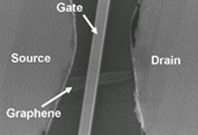
In the scope of his innovative project ALEGRA the AMO nanoelectronics group of Dr. Max Lemme was able to manufacture top-gated transistor-like field-effect devices from monolayer graphene.
Compared to conventional silicon and SOI MOSFETs the researchers realized a significant enhancement of electron and hole mobility.
Moore’s law, which has dictated ambitious innovation cycles to the semiconductor industry over the last decades, may finally be running out of steam. In the future, innovations for silicon technology may only be realized by integrating new functionalities or novel materials.
Carbon is one of the most probable candidates: impressive potential for nanoelectronics applications has been demonstrated with carbon nanotubes – and graphene!
A conventional CMOS-compatible process has been applied to fabricate a graphene field-effect device – a transistor made from a monolayer of carbon. The observed mobility in the devices exceeds the universal mobility in silicon MOSFETs. Furthermore, a second transistor gate was placed on top of the graphene film for the first time. AMO’s results confirm the high potential of graphene for future nanoelectronic devices.
First experimental details will be published in IEEE Electron Device Letters in April 2007.
Citation: M.C. Lemme, T.J. Echtermeyer, M. Baus, H. Kurz, “A Graphene Field Effect Device”, IEEE Electron Device Letters, Vol. 28, No. 4, April 2007.
Source: AMO


