Cold storage solution for global warming?
Feb 07, 2007
Cold storage solution for global warming?
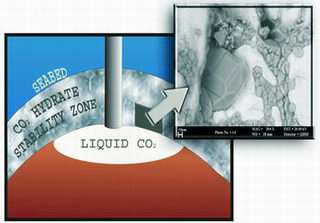
Schematic diagram representing the proposed storage as a liquid and hydrate, with an example image of crystalline carbon dioxide hydrate grown in sediment. Credit: University of Leicester

Researchers from the University of Leicester and the British Geological Society (BGS) have proposed storing CO2 in huge underground reservoirs as a way of reducing emissions- and have even identified sites in Western Europe that would be suitable.
Cold storage solution for global warming?
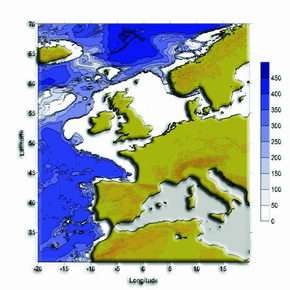
Thickness of the carbon dioxide hydrate stability zone offshore Western Europe (meters), expressed in blue contoured areas, showing large regions with suitable conditions for storage as a liquid and hydrate. The grey zone is outside the study area. Credit: University of Leicester

Their research, published in the journal, Planet Earth, reveals that CO2 can be contained in cool geological aquifers or reservoirs, where it can remain harmlessly for many thousands of years.

PhD research student, Ameena Camps, is working with Professor Mike Lovell at the University's Department of Geology and with Chris Rochelle at BGS, investigating the storage of CO2.

Storing the gas in a solid form as a gas hydrate, or as a pool of liquid CO2 below a cap of hydrate cemented sediments, is believed to offer an alternative method of geological sequestration to the current practices of storage in warm, deep sediments in the North Sea.

Recently quoted in Planet Earth Ameena Camps explained: "Hydrates (also known as clathrates) are ice-like crystalline minerals that look like normal ice and form when gas and water freeze together at low temperature and high pressure. They are made of a cage of frozen water molecules with the gas molecules trapped inside."

Although gas hydrates were first discovered two centuries ago, the possible use of carbon dioxide hydrate as a means to help resolve problems of global climate change, and of naturally occurring methane hydrate as a future source of energy, have only recently been suggested.

Laboratory experiments carried out as part of Ameena Camps' PhD project have indicated that carbon dioxide hydrate should form stable structures in sediments under oceans. By employing geophysical techniques and computer modelling, Ms Camps has identified a number of sites in Western Europe with the potential to store carbon dioxide by this method.

She is also exploring further implications of her research that may benefit geologists' understanding of the stability of deep submarine slopes and contribute to improvements in global water supplies through further understanding of desalination processes.

Professor Mike Lovell, of the University of Leicester Department of Geology commented: "Ms Camps' work is at the forefront of gas hydrate research, and has produced some very exciting results, highlighting the importance of investment in further studies of hydrates.

"Investigations of natural methane hydrates will help our understanding of their role as a natural hazard, while carbon dioxide hydrates are a potential sink for greenhouse gas emissions. This work also has application in other fields such as space research into hydrates on other planetary bodies."

Source: University of Leicester

Explore further: Alaska volcano shoots ash 15,000 feet into the air

add to favorites email to friend print save as pdf

Related Stories

Going greener offshore

Apr 04, 2013

Pei Cheng Chua at the University of Stavanger (UiS) has developed new and better environment-friendly chemicals for use in oil and gas production. The 32-year-old from Malaysia defended her PhD thesis on ...

Models will enable safer deepwater oil production

Apr 01, 2013

Rice University researchers are developing a comprehensive model that will predict how brine, oil and gas drawn from ultra-deep wells react to everything encountered on the way up to the surface and to suggest strategies ...

Japan extracts 'fire ice' gas from seabed

Mar 12, 2013

Japan said Tuesday it had successfully extracted methane hydrate, known as "fire ice", from its seabed, possibly unlocking many years' worth of gas for the resource-starved country.

Recommended for you

Alaska volcano shoots ash 15,000 feet into the air

May 18, 2013

(AP)—One of Alaska's most restless volcanoes has shot an ash cloud 15,000 feet into the air in an ongoing eruption that has drawn attention from a nearby community but isn't expected to threaten air traffic.

NASA sees Cyclone Mahasen hit Bangladesh

May 17, 2013

NASA's Tropical Rainfall Measuring Mission satellite known as TRMM measured Cyclone Mahasen's rainfall rates from space as it made landfall on May 16. Mahasen has since dissipated over eastern India.

Rapid climate change ruled out ice age trees

May 17, 2013

Short, sharp fluctuations in the Earth's climate throughout the last ice age may have stopped trees from getting a foothold in Europe and northern Asia, scientists say.

Earth's iron core is surprisingly weak, researchers say

May 17, 2013

The massive ball of iron sitting at the center of Earth is not quite as "rock-solid" as has been thought, say two Stanford mineral physicists. By conducting experiments that simulate the immense pressures deep in the planet's ...

User comments : 0

More news stories

Galaxy's Ring of Fire

Johnny Cash may have preferred this galaxy's burning ring of fire to the one he sang about falling into in his popular song. The "starburst ring" seen at center in red and yellow hues is not the product of ...

Fracking risks to ground water assessed

(Phys.org) —Extraction of "unconventional" gas from sedimentary rocks such as shale could provide a clean energy source and help some regions to become energy independent, but concerns have been raised ...