Viewing the Future: ILC Simulations
Jan 31, 2007
Viewing the Future: ILC Simulations
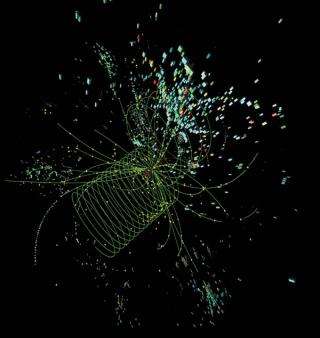
This simulation shows how the ILC would detect the production of two Z bosons. Each of the Z bosons decays into a pair of jets. (Image courtesy of Norman Graf.)

Even though it will still be several years before the International Linear Collider (ILC) comes online, scientists have already conducted millions of collision experiments, using detectors that have not been built yet. This is not the result of a new field of clairvoyant physics, but the power of computer simulations.

Scientists at SLAC and around the world are working on four detector concepts for the ILC: the silicon detector (SiD), the European-based Large Detector Concept (LDC), the Asian-based Global Large Detector (GLC), and a yet unnamed 4th detector concept. Instead of spending expensive resources on prototypes, researchers are using computer simulations to conduct virtual experiments. By doing so, they can optimize detector designs to yield the best science possible.

"We can design the detector on paper, but we make computer simulations and see if these designs are right," said John Jaros, one of the co-leaders of the SiD concept, which is being developed at SLAC. "Are we measuring what we want to measure? Are we measuring them well enough?"

A group led by SLAC physicist Norman Graf has made their simulation software available to the international community. Researchers who want to use the software submit a list of interactions they would like to simulate, as well as configurations for the detector they want to test. The software simulates the particle interactions millions of times, producing a statistical picture of what the actual experiment would look like. The results will not only aid detector designs, but also provide researchers with simulated datasets for scientific analysis.

When the ILC is complete, physicists will be able to compare these simulations with actual experiments. "That's when it gets exciting," Graf said. Deviations from simulations might indicate calculation errors or bugs in the software, but could also hint at exciting scientific discoveries.

"We prepare ourselves for the bug, but we always aspire toward new physics," Graf said.

Source: by Marcus Woo, Stanford Linear Accelerator Center

Explore further: Breakthrough calls time on bootleg booze

add to favorites email to friend print save as pdf

Related Stories

Locust's visual system inspiring new technology

Feb 21, 2013

The way in which the locust's distinctive visual system could be transferred into technology for state of the art vehicle collision sensors, surveilance technology and video games has been detailed as part of robotics research ...

Recommended for you

Breakthrough calls time on bootleg booze

4 hours ago

(Phys.org) —Using a laser, the St Andrews scientists can now carry out detailed analysis of a spirit sample no bigger than a teardrop and can even confirm whether it is toxic or not. It's hoped the testing ...

Bringing life into focus

May 17, 2013

Spinning-disk confocal microscopy is an optical imaging technique that can be used to generate detailed three-dimensional fluorescence images of living cells and their contents. Although a powerful tool for ...

World's smallest droplet

May 17, 2013

(Phys.org) —Physicists may have created the smallest drops of liquid ever made in the lab. That possibility has been raised by the results of a recent experiment conducted by Vanderbilt physicist Julia Velkovska and her ...

User comments : 0

More news stories

Breakthrough calls time on bootleg booze

(Phys.org) —Using a laser, the St Andrews scientists can now carry out detailed analysis of a spirit sample no bigger than a teardrop and can even confirm whether it is toxic or not. It's hoped the testing ...

Competition in the quantum world

Innsbruck physicists led by Rainer Blatt and Peter Zoller experimentally gained a deep insight into the nature of quantum mechanical phase transitions. They are the first scientists that simulated the competition ...

New principle may help explain why nature is quantum

Like small children, scientists are always asking the question 'why?'. One question they've yet to answer is why nature picked quantum physics, in all its weird glory, as a sensible way to behave. Researchers ...

Advance in nanotech gene sequencing technique

(Phys.org) —The allure of personalized medicine has made new, more efficient ways of sequencing genes a top research priority. One promising technique involves reading DNA bases using changes in electrical ...

Finnish start-up launches smartphone to rival giants

A group of ex-Nokia employees who quit over the company's decision to abandon the planned MeeGo operating system in favour of Windows presented their own smartphone on Monday, hoping to rival the sector's ...