Famous Space Pillars Feel the Heat of Star's Explosion
Jan 09, 2007
Cosmic Epic Unfolds in Infrared
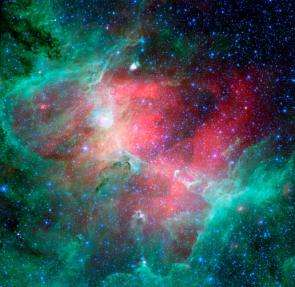
Infrared view of the Eagle nebula. Image credit: NASA/JPL-Caltech/ Institut d'Astrophysique Spatiale

The three iconic space pillars photographed by NASA's Hubble Space Telescope in 1995 might have met their demise, according to new evidence from NASA's Spitzer Space Telescope.

A new, striking image from Spitzer shows the intact dust towers next to a giant cloud of hot dust thought to have been scorched by the blast of a star that exploded, or went supernova. Astronomers speculate that the supernova's shock wave could have already reached the dusty towers, causing them to topple about 6,000 years ago. However, because light from this region takes 7,000 years to reach Earth, we won't be able to capture photos of the destruction for another 1,000 years or so.

Spitzer's view of the region is online at www.spitzer.caltech.edu . It shows the entire Eagle nebula, a vast and stormy community of stars set amid clouds and steep pillars made of gas and dust, including the three well-known "Pillars of Creation."

"I remember seeing a photograph of these pillars more than a decade ago and being inspired to become an astronomer," said Nicolas Flagey of The Institut d'Astrophysique Spatiale in France. "Now, we have discovered something new about this region we thought we understood so well." Flagey, a visiting graduate student at NASA's Spitzer Science Center at the California Institute of Technology in Pasadena, presented the results today at the American Astronomical Society meeting in Seattle.

Astronomers have long predicted that a supernova blast wave would mean the end for the popular pillars. The region is littered with 20 or so stars ripe for exploding, so it was only a matter of time, they reasoned, before one would blow up. The new Spitzer observations suggest one of these stellar time bombs has in fact already detonated, an event humans most likely witnessed 1,000 to 2,000 years ago as an unusually bright star in the sky.

Whenever the mighty pillars do crumble, gas and dust will be blown away, exposing newborn stars that were forming inside. A new generation of stars might also spring up from the dusty wreckage.

Spitzer is a space telescope that detects infrared, longer-wavelength light that our eyes cannot see. This allows the observatory to both see the dust and see through it, depending on which infrared wavelength is being observed. In Spitzer's new look at the Eagle nebula, the three pillars appear small and ghostly transparent. They are colored green in this particular view. In the largest of the three columns, an embedded star is seen forming inside the tip.

Above the pillars is the enormous cloud of hot dust, colored red in the picture, which astronomers think was seared by the blast wave of a supernova explosion. Flagey and his team say evidence for this scenario comes from similarities observed between this hot dust and dust around known supernova remnants. The dust also appears to have a shell-like shape, implying that a supernova blast wave is traveling outward and sculpting it.

The mysterious dust was first revealed in previous images from the European Space Agency's Infrared Space Observatory, but Spitzer's longer-wavelength infrared instrument was able to tentatively match the dust to a supernova event.

"Something else besides starlight is heating this dust," said Dr. Alberto Noriega-Crespo, Flagey's advisor at the Spitzer Science Center. "With Spitzer, we now have the missing long-wavelength infrared data that are giving us an answer."

Source: NASA

Explore further: Hubble reveals the ring nebula's true shape

add to favorites email to friend print save as pdf

Related Stories

Eagle Nebula: A new view of an icon

Jan 17, 2012

(PhysOrg.com) -- The Eagle Nebula as never seen before. In 1995, the Hubble Space Telescope's 'Pillars of Creation' image of the Eagle Nebula became one of the most iconic images of the 20th century. Now, ...

Before they were stars: New image shows space nursery

Jan 10, 2012

(PhysOrg.com) -- The stars we see today weren't always as serene as they appear, floating alone in the dark of night. Most stars, likely including our sun, grew up in cosmic turmoil — as illustrated in ...

Experience Hubble's Universe in 3-D (w/ Video)

Mar 19, 2010

(PhysOrg.com) -- Take an exhilarating ride through the Orion Nebula, a vast star-making factory 1,500 light-years away. Swoop through Orion's giant canyon of gas and dust. Fly past behemoth stars whose brilliant ...

Spitzer Reveals Stellar "Family Tree"

Aug 22, 2008

A new image from NASA's Spitzer Space Telescope tells a tale of life and death, and reveals a rich family history. The striking infrared picture shows a colorful cosmic cloud, called W5, studded with multiple ...

Recommended for you

Hubble reveals the ring nebula's true shape

1 hour ago

(Phys.org) —The Ring Nebula's distinctive shape makes it a popular illustration for astronomy books. But new observations by NASA's Hubble Space Telescope of the glowing gas shroud around an old, dying, ...

A hidden population of exotic neutron stars

6 hours ago

(Phys.org) —Magnetars – the dense remains of dead stars that erupt sporadically with bursts of high-energy radiation - are some of the most extreme objects known in the Universe. A major campaign using ...

Very Large Telescope celebrates 15 years of success

11 hours ago

(Phys.org) —With this new view of a spectacular stellar nursery ESO is celebrating 15 years of the Very Large Telescope—the world's most advanced optical instrument. This picture reveals thick clumps ...

Fragile mega-galaxy is missing link in history of cosmos

May 22, 2013

Two hungry young galaxies that collided 11 billion years ago are rapidly forming a massive galaxy about 10 times the size of the Milky Way, according to UC Irvine-led research published Wednesday in the journal ...

User comments : 0

More news stories

Hubble reveals the ring nebula's true shape

(Phys.org) —The Ring Nebula's distinctive shape makes it a popular illustration for astronomy books. But new observations by NASA's Hubble Space Telescope of the glowing gas shroud around an old, dying, ...

A hidden population of exotic neutron stars

(Phys.org) —Magnetars – the dense remains of dead stars that erupt sporadically with bursts of high-energy radiation - are some of the most extreme objects known in the Universe. A major campaign using ...

NASA head views progress on asteroid lasso mission

Surrounded by engineers, NASA chief Charles Bolden inspected a prototype spacecraft engine that could power an audacious mission to lasso an asteroid and tow it closer to Earth for astronauts to explore.

Controlling mood through the motions of mitochondria

(Medical Xpress)—Regulating the distribution of power in neurons is done by a system that makes the national electric grid look simple by comparison. Each neuron has several thousand mitochondria confined ...

Google Drive sports new view and scan enhancements

(Phys.org) —Google Drive has a new look and functions. The makeover in Google Drive features scanning and interface enhancements that put the user into "card" mode. The enhancements make it easy for the ...