November 30, 2006 feature
How to Shrink a Carbon Nanotube
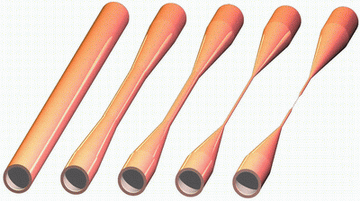
A research group has devised a way to control the diameter of a carbon nanotube – down to essentially zero nanometers. This useful new ability, designed by scientists from the University of California at Berkeley and Lawrence Berkeley National Laboratory, may help carbon nanotubes become more easily incorporated into new technologies.
“One of the biggest hurdles in working with carbon nanotubes has been lack of control over their size,” said UC Berkeley physicist Tom Yuzvinsky, the study's lead author, to PhysOrg.com. “Now that we can precisely set the diameter of carbon nanotubes, we can tailor individual nanoscale devices to meet our needs.”
The exceptional electrical and physical properties of carbon nanotubes – for example, they conduct very well and are extremely strong – have led them to become the basis of many nanoscale devices, such as sensors and transistors. But since these properties depend on the size of the nanotubes and methods to precisely control their size have been unreliable, nanotubes have not been as thoroughly incorporated into new technologies as many scientists would like.
Yuzvinsky and his colleagues have taken a significant step toward changing this.
They began with a multi-walled carbon nanotube (which resembles a few single nanotubes nested together); theirs had four walls. They applied a carefully selected voltage to the nanotube, which caused the outer two walls to break down electrically and fall away. The already-slimmer nanotube was next bombarded with a high-energy electron beam that knocked carbon atoms out of the nanotube, creating vacancies and other defects in its atomic structure. Simultaneously, the group ran a current through the nanotube. This heated it to the point where it could heal its vacancies and defects by spontaneously reforming into a narrower, nearly defect-free nanotube.
Repeating this process shrank the nanotube gradually and controllably in a matter of minutes. As the diameter dwindled, Yuzvinsky and his collaborators were careful to adjust the current through nanotube to account for its increasing electrical resistance. This yielded a surprising and important secondary result of their work: that the conductance of a multi-walled carbon nanotube is directly proportional to its diameter. This clears up many conflicting studies of electrical conduction in nanotubes.
The researchers followed the changes as they occurred using a transmission electron microscope, which produced detailed images of the nanotube. Eventually, they could see that the nanotube became so narrow (less than one nanometer) that the inner wall broke, leaving two nanotube fragments connected by an unstable bridge of carbon atoms that soon failed as well.
Citation: T.D. Yuzvinsky, W. Mickelson, S. Aloni, G.E. Begtrup, A. Kis, and A. Zettl, “Shrinking a Carbon Nanotube.” Nano Lett. (2006) DOI: 10.1021/nl061671j
By Laura Mgrdichian, Copyright 2006 PhysOrg.com


