Phishing and pharming and fraud, oh my! Sleuthing the cyber swindlers
Technology has transformed the Internet into an accessible and speedy superhighway, yet it also has paved slick paths for crooks to prey upon innocent online travelers.
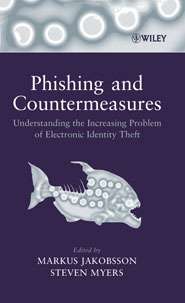
That's the focus of Phishing and Countermeasures: Understanding the Increasing Problem of Electronic Identity Theft (John Wiley & Sons Inc.), a new book written and edited by scientists at the Indiana University School of Informatics. The book -- one of the first of its kind to cover such issues -- explores and explains the sophisticated methods cyber crooks use to steal financial and other personal information from consumers, and conduct corporate and military espionage.
The book describes likely trends in online fraud, and possible countermeasures that can benefit corporations, administrators and developers using the Internet.
The 736-page tome delves into the technology behind phishing, pharming, spam and click-fraud. As the title of the book suggests, the focus is on phishing (using e-mail or instant messages to direct the recipient to a fraudulent Website that appears legitimate), but the coverage goes far beyond the common attacks and countermeasures of today.
"I have been asked by many whether it is ethical to publish a book that may help the bad guys as well as the good guys," said Markus Jakobsson, associate professor, who co-edited the book with Steven Myers, assistant professor. "It's a textbook about cyber crime, its likely trends and what to do to counter it. In many ways the bad guys already have a lead, and it's our goal that Phishing and Countermeasures will help level the playing field for the good guys."
Myers said the book draws from a broad range of disciplines, including computer science, human-computer interaction design, psychology and law, and that it reflects the School of Informatics' goal of advancing research on a global scale.
"Apart from describing phishing in North America, the book addresses phishing scenarios in Germany, China and Japan, as well as other types of cyber attacks in those countries," Myers said.
Among the IU contributors to the book are Distinguished Professor of Law Fred Cate, who is internationally known as an expert in privacy issues and the Internet and directs the IU-based Center for Applied Cybersecurity Research; and Peter Finn, professor of psychological and brain sciences and chair of the Institutional Review Board at IU-Bloomington.
External contributors include computer and network security experts Ron Rivest, Massachusetts Institute of Technology; Dan Boneh, Stanford University; and J.D. Tygar, University of California-Berkeley.
"Because there is at least one sucker born every minute, and the Internet puts them all into a huge convenient circus tent, phishing, pharming and other spoofing attacks have risen to the top as the most dangerous computer security risks," said Gary McGraw, chief technology officer of Cigital Inc., and author of Software Security.
"The writers and editors of this book go far beyond the basics of problem exposition, covering solutions, legal status and advanced research," McGraw added. "They help Internet users gird themselves for battle against the identity thieves."
Details about Phishing and Countermeasures: Understanding the Increasing Problem of Electronic Identity Theft, are at http://phishing-an … easures.info .
More information about anti-phishing research activities at Indiana University is at http://www.stop-phishing.com .
Source: Indiana University
-
From lemons to lemonade: Reaction uses carbon dioxide to make carbon-based semiconductor,
32 comments
-
Thioridazine kills cancer stem cells in human while avoiding toxic side-effects of conventional cancer treatments,
3 comments
-
SpaceX private rocket blasts off for space station (Update),
42 comments
-
Climate scientists say they have solved riddle of rising sea,
31 comments
-
SpaceX capsule has 'new car' smell, astronauts say (Update),
4 comments
-
Ideas to mitigate risk of 911 calls being misdirected
May 24, 2012
-
Live scribe pen?
May 10, 2012
-
Shallow water flow simulation
May 07, 2012
-
Tablet for taking notes?
May 05, 2012
-
Best fit tablet for me?
May 05, 2012
-
Measure of Informaton
May 04, 2012
- More from Physics Forums - Computing & Technology
More news stories
Browser wars flare in mobile space
The browser wars are heating up again, but this time the fight is for dominance of the mobile Internet.
18 hours ago |
4 / 5 (4) |
3
Probability of contamination from severe nuclear reactor accidents is higher than expected: study
Catastrophic nuclear accidents such as the core meltdowns in Chernobyl and Fukushima are more likely to happen than previously assumed. Based on the operating hours of all civil nuclear reactors and the number ...
Technology / Energy & Green Tech
May 22, 2012 |
3.6 / 5 (25) |
56
|
HyperSolar shows dirty water no barrier to power world
(Phys.org) -- The Santa Barbara, California, company, HyperSolar, is set to transparently share the ups and downs of its research experiences toward the companys ultimate vision, successfully producing ...
SpotterRF debuts Radar Backpack Kit (w/ Video)
(Phys.org) -- SpotterRF has announced a special radar backpack kit designed to enhance situational awareness for soldiers on the ground. The company says its special radar is designed for warfighters as part ...
Tesla to launch electric sedan in US on June 22
Tesla Motors said Tuesday it would begin deliveries of "the world's first premium electric sedan" on June 22, slightly ahead of schedule.
Technology / Energy & Green Tech
May 22, 2012 |
4.5 / 5 (12) |
18
'Unzipped' carbon nanotubes could help energize fuel cells, batteries
Multi-walled carbon nanotubes riddled with defects and impurities on the outside could replace some of the expensive platinum catalysts used in fuel cells and metal-air batteries, according to scientists at ...
Change in developmental timing was crucial in the evolutionary shift from dinosaurs to birds: study
At first glance, it's hard to see how a common house sparrow and a Tyrannosaurus Rex might have anything in common. After all, one is a bird that weighs less than an ounce, and the other is a dinosaur that ...
Computer model used to pinpoint prime materials for efficient carbon capture
When power plants begin capturing their carbon emissions to reduce greenhouse gases and to most in the electric power industry, it's a question of when, not if it will be an expensive undertaking.
T cells 'hunt' parasites like animal predators seek prey, study shows
By pairing an intimate knowledge of immune-system function with a deep understanding of statistical physics, a cross-disciplinary team at the University of Pennsylvania has arrived at a surprising finding: T cells use a movement ...
Stunning image of smallest possible five-ringed structure
Scientists have created and imaged the smallest possible five-ringed structure about 100,000 times thinner than a human hair and you'll probably recognise its shape.
Land and sea species differ in climate change response: study
(Phys.org) -- Marine and terrestrial species will likely differ in their responses to climate warming, new research by Simon Fraser University and Australia’s University of Tasmania has found.