Lesser Flamingos Find Refuge at Kenyan Lake
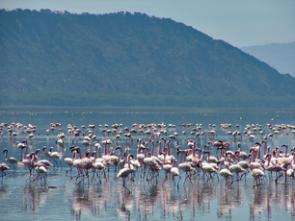
Lesser flamingos are surprising scientists by flocking to one of Kenya’s smallest lakes for the first time, by the thousands. Earthwatch-supported scientist Dr. David Harper, of the University of Leicester, reports that Lake Oloidien recently turned saline for the first time, making it good feeding habitat for the near-threatened birds.
“Word is spreading that there is food at Oloidien,” said Harper, principal investigator of Earthwatch’s Lakes of the Rift Valley project. “Last time I looked there were nearly a quarter of a million flamingos there. Oloidien water, though far too saline for humans or cattle to drink, is not too saline for flamingos. What we have is a remarkable and rare spectacle of groups of lesser flamingos feeding, drinking, and bathing in the same place.”
Lake Oloidien is a volcanic crater lake found at the southwest corner of Lake Naivasha, home to Kenya’s largest flower farms and a popular tourist attraction. Oloidien, which used to be connected to Naivasha, has steadily been going saline since its water levels fell and it became a separate lake in 1979. In July 2006, it passed the magic salinity mark and began to produce bacteria called Spirulina, the main food for lesser flamingos.
This news follows the sudden deaths of thousands of lesser flamingos at Lake Nakuru and Lake Elmenteita in March this year. Lake Oloidien has not been without its mortalities as well, and few hundred lesser flamingos have already died here. Kenya's lesser flamingos also suffered three mysterious “die-offs” in the 1990s, with a cumulative loss of at least 250,000 birds.
“In March, the lesser flamingo population suddenly increased on the main Kenyan lakes,” said Harper. “At Nakuru, numbers grew from a few thousand to almost a quarter of a million. Elmenteita’s went from almost nothing to 70,000. The increase in numbers of healthy birds was accompanied by deaths, but at each lake, only two per cent of the population died. It is quite possible that the dead birds were weakened by their travels and became susceptible to disease, which spread quickly in their crowded groups.”
In an effort to resolve the mystery of the flamingo deaths, Harper will lead a research team at Lake Bogoria in November in partnership with Earthwatch, the University of Nairobi, National Museums of Kenya, Kenya Wildlife Services, and Tanzanian equivalent bodies. A veterinarian and a bacterial toxin expert will also be present. The team hopes to examine current theories of flamingo mortality in order to provide the scientific and conservation community with answers.
“The massed ranks of flamingos, which sometimes occurs in flocks of over a million on one lake, make a spectacular sight equivalent to the wildebeest on the Serengeti Plain of Tanzania,” continued Harper. Despite these numbers and density, lesser flamingos are considered to be a ‘near-threatened’ species because their numbers are only about half of those formerly recorded.
For 18 years, Earthwatch teams have assisted Harper and his colleagues in their efforts to understand the ecology of Kenya’s Rift Valley lakes and wildlife. Their findings have resulted in more than 50 articles in scientific journals and helped spur conservation efforts both locally and internationally. Their results have ranged from charting the cycle of destruction and regrowth caused by the introduced Louisiana crayfish in Lake Naivasha to satellite-tracking the movements of flamingos from lake to lake.
Earthwatch teams will return to Kenya to help Dr. Harper's team in 2007. For more information about Earthwatch’s Lakes of the Rift Valley project, go to www.earthwatch.org/site/pp.asp … sJSK6PFJnH&b=2243863
Earthwatch Institute is a global volunteer organization that supports scientific field research by offering members of the public unique opportunities to work alongside leading field scientists and researchers. Earthwatch’s mission is to engage people worldwide in scientific field research and education to promote the understanding and action necessary for a sustainable environment. The year 2006 marks Earthwatch’s 35th anniversary.
Be sure to watch A Year on Earth, a two-part special to debut on Discovery Kids Channel on December 3 and 10. A Year on Earth chronicles the adventures of three American teens who join Dr. Harper's team in Kenya and several other Earthwatch research projects around the world. Together, they discover how ordinary people can make a difference in the most pressing environmental issues of our time.
Source: Earthwatch Institute


