Engineers develop revolutionary nanotech water desalination membrane
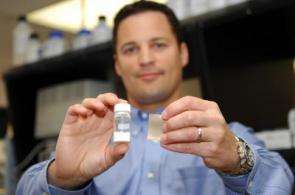
Researchers at the UCLA Henry Samueli School of Engineering and Applied Science today announced they have developed a new reverse osmosis (RO) membrane that promises to reduce the cost of seawater desalination and wastewater reclamation.
Reverse osmosis desalination uses extremely high pressure to force saline or polluted waters through the pores of a semi-permeable membrane. Water molecules under pressure pass through these pores, but salt ions and other impurities cannot, resulting in highly purified water.
The new membrane, developed by civil and environmental engineering assistant professor Eric Hoek and his research team, uses a uniquely cross-linked matrix of polymers and engineered nanoparticles designed to draw in water ions but repel nearly all contaminants. These new membranes are structured at the nanoscale to create molecular tunnels through which water flows more easily than contaminants.
Unlike the current class of commercial RO membranes, which simply filter water through a dense polymer film, Hoek's membrane contains specially synthesized nanoparticles dispersed throughout the polymer -- known as a nanocomposite material.
"The nanoparticles are designed to attract water and are highly porous, soaking up water like a sponge, while repelling dissolved salts and other impurities," Hoek said. "The water-loving nanoparticles embedded in our membrane also repel organics and bacteria, which tend to clog up conventional membranes over time."
With these improvements, less energy is needed to pump water through the membranes. Because they repel particles that might ordinarily stick to the surface, the new membranes foul more slowly than conventional ones. The result is a water purification process that is just as effective as current methods but more energy efficient and potentially much less expensive. Initial tests suggest the new membranes have up to twice the productivity -- or consume 50 percent less energy -- reducing the total expense of desalinated water by as much as 25 percent.
"The need for a sustainable, affordable supply of clean water is a key priority for our nation's future and especially for that of California -- the fifth largest economy in the world," Hoek said. "It is essential that we reduce the overall cost of desalination -- including energy demand and environmental issues -- before a major draught occurs and we lack the ability to efficiently and effectively increase our water supply."
A critical limitation of current RO membranes is that they are easily fouled -- bacteria and other particles build up on the surface and clog it. This fouling results in higher energy demands on the pumping system and leads to costly cleanup and replacement of membranes. Viable alternative desalination technologies are few, though population growth, over-consumption and pollution of the available fresh water supply make desalination and water reuse ever more attractive alternatives.
With his new membrane, Hoek hopes to address the key challenges that limit more widespread use of RO membrane technology by making the process more robust and efficient.
"I think the biggest mistake we can make in the field of water treatment is to assume that reverse osmosis technology is mature and that there is nothing more to be gained from fundamental research," Hoek said. "We still have a long way to go to fully explore and develop this technology, especially with the exciting new materials that can be created through nanotechnology.
Hoek is working with NanoH2O, LLP, an early-stage partnership, to develop his patent-pending nanocomposite membrane technology into a new class of low-energy, fouling-resistant membranes for desalination and water reuse. He anticipates the new membranes will be commercially available within the next year or two.
"We as a nation thought we had enough water, so a decision was made in the 1970s to stop funding desalination research," Hoek said. "Now, 30 years later, there is renewed interest because we realize that not only are we running out of fresh water, but the current technology is limited, we lack implementation experience and we are running out of time. I hope the discovery of new nanotechnologies like our membrane will continue to generate interest in desalination research at both fundamental and applied levels."
Source: University of California - Los Angeles


