Robotic Boat Geared to Simplify Life for Scientists
Nov 02, 2006
Robotic Boat Geared to Simplify Life for Scientists
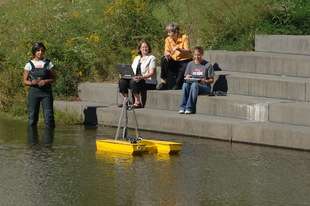
Rowan University faculty and staff start IMAPS on a journey on a local body of water. Powered by a laptop, IMAPS can sample water and save researchers from mulitple treks in and out of ponds, lakes and other bodies. Credit: Craig Terry

Though it looks like a miniature yellow catamaran, a craft designed by professors and students at Rowan University is not your father’s toy boat.

Indeed, the wooden boat actually is a robotic flotation device and research tool called Interactive Mobile Aqua Probing & Surveillance or IMAPS. Faculty and students in the College of Engineering and the Biological Sciences Department in the College of Liberal Arts & Sciences—both of which emphasize experimental design and hands-on learning—collaborated on IMAPS. They designed the 4’x3’x1’, 50-pound, laptop computer-operated boat to sample water parameters as part of environmental research and pollution monitoring.

The motor-driven IMAPS carries instruments that can measure water’s temperature; depth; and pH, dissolved oxygen, nitrite, nitrate and ammonia levels and features a camera that can show what’s below the water’s surface. With a laptop and Internet, a nearby or far away user can guide the IMAPS via a GPS device and onboard camera to different parts of a water body.

That’s an improvement over typical field sampling methods, which call for scientists to move in and out of water taking samples or travel from one spot to another via boat and then return the samples to a laboratory for analysis.

“IMAPS is very flexible. It can go into creeks, onto marshy surfaces and travel between tidal areas,” said Dr. Courtney Richmond, associate professor of biological sciences.

Dr. Patricia Mosto, interim associate provost and former chair of the Biological Sciences Department, initiated the idea with Dr. Hong Zhang, assistant professor of electrical and computer engineering. Mosto said, “There is nothing like this for small bodies of water. Most devices are attached to buoys or are manually submersible. Generally scientists on boats move from location to location getting samples by hand. With IMAPS, you can be in your office and it can sample a lake for you.”

“Although some current technologies provide a basic way to continuously observe fixed positions, their lack of crucial mobility and flexibility inspired our team to develop a robotic IMAPS device to monitor water pollution and study ecological conditions,” Zhang said. “Our goal is to enable students from anywhere to retrieve data collected by a fleet of IMAPS deployed in various locations.”

The team hopes one day to make the device available to others schools and researchers. “IMAPS is inexpensive to acquire and maintain while intuitive to operate. Many students, especially those at financially disadvantaged schools, can have unprecedented access to research equipment and be able to explore the wild or test water quality either (locally) or on a virtual field trip half world away.” Zhang said. He said IMAPS also will be a convenient tool for local communities to use, enabling a greater number of people to easily monitor water pollution and pinpoint a polluting source.

To date, 11 students have worked with Zhang, Mosto, Richmond and Dr. Gina Tang, assistant professor of electrical and computer engineering, on the project for the last 20 months. The team received a provisional patent for IMAPS in the spring.

This semester students and their professors are working on IMAPS II, an amphibious device that will be able to travel between land and water on its own power. It will be used to work on creeks, marshes and other difficult terrains.

Source: Rowan University

Explore further: Congress gets mixed advice on regulating drones

add to favorites email to friend print save as pdf

Related Stories

Bonaparte family letter to return to France

1 hour ago

(Phys.org) —A handwritten letter dated April 27, 1792, signed by Joseph Bonaparte and referring to a skirmish in Corsica involving Napoleon, the writer's then 22-year-old brother, will be returned to its ...

British children's on-screen reading overtakes books

1 hour ago

For the first time, British children are reading more on computers and other electronic devices than they are reading books, magazines, newspapers and comics, according to a study of nearly 35,000 youngsters ...

CTRL+P: Printing Australia's largest solar cells

1 hour ago

(Phys.org) —The printer has allowed researchers from the Victorian Organic Solar Cell Consortium (VICOSC) – a collaboration between CSIRO, The University of Melbourne, Monash University and industry partners ...

Novel probe for live human iPS cell imaging

1 hour ago

Researchers from the National Institute of Advanced Industrial Science and Technology (AIST) have developed a highly sensitive lectin probe, rBC2LCN, for human induced pluripotent stem cells (iPS cells). ...

Recommended for you

Expectations high for next Xbox

16 minutes ago

It's almost time for a new Xbox. Eight years have passed since Microsoft unveiled the Xbox 360, double the amount of time between the original Xbox debut in 2001 and its high-definition successor's launch ...

Congress gets mixed advice on regulating drones

May 17, 2013

(AP)—The growing use of unmanned surveillance "eyes in the sky" aircraft raises a thicket of privacy concerns, but the U.S. Congress is getting mixed advice on what, if anything, to do about it.

Makr Shakr uses three arms for drink-recipe collabs

May 15, 2013

(Phys.org) —We're told it's the wave of the future. Design, make, enjoy. Beyond home-based 3-D printers, there will be new machines and display screens and apps that will invite you to have day to day products ...

User comments : 0

More news stories

Expectations high for next Xbox

It's almost time for a new Xbox. Eight years have passed since Microsoft unveiled the Xbox 360, double the amount of time between the original Xbox debut in 2001 and its high-definition successor's launch ...

Congress gets mixed advice on regulating drones

(AP)—The growing use of unmanned surveillance "eyes in the sky" aircraft raises a thicket of privacy concerns, but the U.S. Congress is getting mixed advice on what, if anything, to do about it.

Makr Shakr uses three arms for drink-recipe collabs

(Phys.org) —We're told it's the wave of the future. Design, make, enjoy. Beyond home-based 3-D printers, there will be new machines and display screens and apps that will invite you to have day to day products ...

RIM unveils cheaper BlackBerry (Update 2)

Research In Motion unveiled a lower-cost BlackBerry aimed at consumers in emerging markets on Tuesday, and said it will offer its once-popular BlackBerry Messenger service on iPhones and devices running Google's ...

Lovelorn frogs bag closest crooner

What lures a lady frog to her lover? Good looks, the sound of his voice, the size of his pad or none of the above? After weighing up their options, female strawberry poison frogs (Oophaga pumilio) bag th ...