Scientists discover new ring and other features at Saturn
Sep 20, 2006
The Janus/Epimetheus Ring
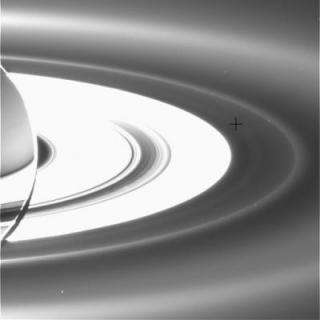
A new diffuse ring, coincident with the orbits of Saturn's moons Janus and Epimetheus, has been revealed in ultra-high phase angle views from Cassini. The new ring is visible in this image (marked by a cross) outside the overexposed main rings and interior to the G and E rings. The G ring has a sharp inner boundary; the E ring is extremely broad and arcs across the upper and lower portions of the scene. While it is not unexpected that impact events on Janus and Epimetheus might kick particles off the moons' surfaces and inject them into Saturn orbit, it is, however, surprising that a well-defined structure exists at this location. The view looks down from about 15 degrees above the unilluminated side of the rings. Some faint spokes can also be spotted in the main rings, made visible by sunlight diffusing through the B ring. The image was taken in visible light with the Cassini spacecraft wide-angle camera on Sept. 15 at a distance of approximately 2.2 million kilometers (1.3 million miles) from Saturn and at a Sun-Saturn-spacecraft angle of almost 179 degrees. Image scale is 130 kilometers (81 miles) per pixel. Credit: Credit: NASA/JPL/Space Science Institute NASA/JPL/Space Science Institute

Saturn sports a new ring in an image taken by NASA's Cassini spacecraft on Sunday, Sept. 17, during a one-of-a-kind observation.

Other spectacular sights captured by Cassini's cameras include wispy fingers of icy material stretching out tens of thousands of kilometers from the active moon, Enceladus, and a cameo color appearance by planet Earth.

The images were obtained during the longest solar occultation of Cassini's four-year mission. During a solar occultation, the sun passes directly behind Saturn, and Cassini lies in the shadow of Saturn while the rings are brilliantly backlit. Usually, an occultation lasts only about an hour, but this time it was a 12-hour marathon.

Sunday's occultation allowed Cassini to map the presence of microscopic particles that are not normally visible across the ring system. As a result, Cassini saw the entire inner Saturnian system in a new light.

The new ring is a tenuous feature, visible outside the brighter main rings of Saturn and inside the G and E rings, and coincides with the orbits of Saturn's moons Janus and Epimetheus. Scientists expected that meteoroid impacts on Janus and Epimetheus might kick particles off the moons' surfaces and inject them into Saturn orbit, but they were surprised that a well-defined ring structure exists at this location.

Saturn's extensive, diffuse E ring, the outermost ring, had previously been imaged one small section at a time. The 12-hour marathon enabled scientists to see the entire structure in one view. The moon Enceladus is seen sweeping through the E ring, extending wispy, fingerlike projections into the ring. These very likely consist of tiny ice particles being ejected from Enceladus' south polar geysers, and entering the E-ring.

"Both the new ring and the unexpected structures in the E ring should provide us with important insights into how moons can both release small particles and sculpt their local environments," said Matt Hedman, a research associate working with team member Joseph Burns, an expert in diffuse rings, at Cornell University in Ithaca, N.Y.

In the latest observations, scientists once again see the bright ghost-like spokes--transient, dusty, radial structures--streaking across the middle of Saturn's main rings.

Capping off the new batch of observations, Cassini cast its powerful eyes in our direction and captured Earth, a pale blue orb, and a faint suggestion of our moon. Not since NASA's Voyager 1 spacecraft saw Earth as a pale blue dot from beyond the orbit of Neptune has Earth been imaged in color from the outer solar system.

"Nothing has greater power to alter our perspective of ourselves and our place in the cosmos than these images of Earth we collect from faraway places like Saturn," said Carolyn Porco, Cassini imaging team leader at the Space Science Institute, Boulder, Colo. Porco was one of the Voyager imaging scientists involved in taking the Voyager 'Pale Blue Dot' image. "In the end, the ever-widening view of our own little planet against the immensity of space is perhaps the greatest legacy of all our interplanetary travels."

In the coming weeks, several science teams will analyze data collected by Cassini's other instruments during this rare occultation event. The data will help scientists better understand the relationship between the rings and moons, and will give mission planners a clearer picture of ring hazards to avoid during future ring crossings.

Source: Cassini Imaging Central Laboratory for Operations

Explore further: NASA builds unusual testbed for analyzing X-ray navigation technologies

add to favorites email to friend print save as pdf

Related Stories

Cassini observes meteors colliding with Saturn's rings

Apr 25, 2013

(Phys.org) —NASA's Cassini spacecraft has provided the first direct evidence of small meteoroids breaking into streams of rubble and crashing into Saturn's rings. These observations make Saturn's rings ...

Saturn's little wavemaking moon

Apr 25, 2013

Captured on January 15, this narrow-angle Cassini image shows an outer portion of Saturn's A ring on the left and the ropy F ring crossing on the right. The thin black line near the A ring's bright edge is ...

Image: Facing Enceladus

Apr 23, 2013

(Phys.org) —A patchwork network of frozen ridges and troughs cover the face of Enceladus, Saturn's most enigmatic of icy moons.

Saturn is like an antiques shop, Cassini suggests

Mar 27, 2013

(Phys.org) —A new analysis of data from NASA's Cassini spacecraft suggests that Saturn's moons and rings are gently worn vintage goods from around the time of our solar system's birth.

Recommended for you

Galaxy's Ring of Fire

May 18, 2013

Johnny Cash may have preferred this galaxy's burning ring of fire to the one he sang about falling into in his popular song. The "starburst ring" seen at center in red and yellow hues is not the product of ...

User comments : 0

More news stories

NASA's BARREL mission launches 20 balloons

(Phys.org) —In Antarctica in January, 2013 – the summer at the South Pole – scientists released 20 balloons, each eight stories tall, into the air to help answer an enduring space weather question: ...

Power of US tornado dwarfs Hiroshima bomb

Wind, humidity and rainfall combined precisely to create Monday's massive killer tornado in Oklahoma. The awesome amount of energy released dwarfed the power of the atomic bomb that leveled Hiroshima.

If you can remember it, you can remember it wrong

(Medical Xpress)—Native peoples in regions where cameras are uncommon sometimes react with caution when their picture is taken. The fear that something must have been stolen from them to create the photo ...

Encouraging signs for bee biodiversity

Declines in the biodiversity of pollinating insects and wild plants have slowed in recent years, according to a new study. Researchers led by the University of Leeds and the Naturalis Biodiversity Centre in the Netherlands ...

B vitamins could delay dementia

(Medical Xpress)—Despite spending billions of dollars on research and development, drug companies have been unable to come up with effective treatments for dementia and Alzheimer's Disease (AD). Now, A. ...