Nanoscientists Create Biological Switch from Spinach Molecule
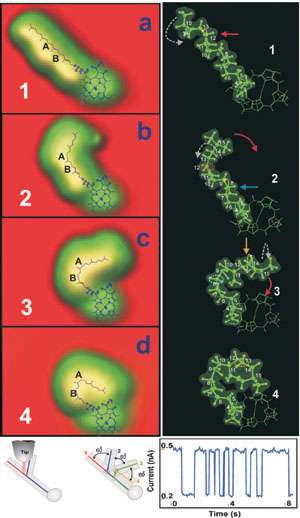
Nanoscientists have transformed a molecule of chlorophyll-a from spinach into a complex biological switch that has possible future applications for green energy, technology and medicine.
The study offers the first detailed image of chloropyhll-a – the main ingredient in the photosynthesis process – and shows how scientists can use new technology to manipulate the configuration of the spinach molecule in four different arrangements, report Ohio University physicists Saw-Wai Hla and Violeta Iancu in today’s early edition of the journal Proceedings of the National Academy of Sciences.
The scientists used a scanning tunneling microscope to image chlorophyll-a and then injected it with a single electron to manipulate the molecule into four positions, ranging from straight to curved, at varying speeds. (View a movie here) Though the Ohio University team and others have created two-step molecule switches using scanning tunneling microscope manipulation in the past, the new experiment yields a more complex multi-step switch on the largest organic molecule to date.
The work has immediate implications for basic science research, as the configuration of molecules and proteins impacts biological functions. The study also suggests a novel route for creating nanoscale logic circuits or mechanical switches for future medical, computer technology or green energy applications, said Hla, an associate professor of physics.
“It’s important to understand something about the chlorophyll-a molecule for origin of life and solar energy conversion issues,” he said.
Source: Ohio University


