Scientists plan new space mission to observe quantum gravity
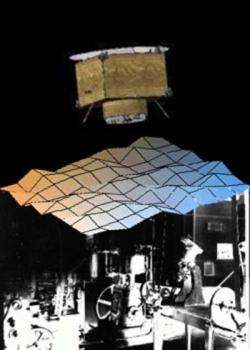
Physicists in the UK have made an exciting breakthrough and are developing plans for a new space mission that could carry out a range of fundamental physics experiments, which will involve placing a high-precision instrument on board a space craft.
A University of Aberdeen scientist is leading this research to show, for the first time, how quantum gravity may be observed in space. According to Dr Charles Wang, a Reader in the College of Physical Sciences and a member of the Aberdeen Centre for Applied Dynamics Research, space-time is constantly deformed by ‘gravitons’ - particles that are believed to mediate gravity at an extremely small scale. This is just like the way in which pollen grains or smoke particles in air have a random ‘Brownian motion’ as they are buffeted by much smaller molecules. He said: “By observing these tiny distortions in a quantum experiment, we think it will be possible to extract information on the ultimate theory of space-time.”
Dr Wang explains that there is a widely held perception in modern physics that the perpetual warping of space-time due to its quantum properties is too small to be seen in any normal circumstances.
However, new research by Dr Wang and his collaborators - Professor R. Bingham (Rutherford Appleton Laboratory in Oxfordshire) and Professor J. T. Mendonça (Instituto Superior Tecnico in Portugal) - suggests that signatures of quantum space-time are very close to being observed in the laboratory and that investigating physics on the most microscopic scale is now a real opportunity. Their results will be reported in a paper which appears this week in New Scientist and The Physics World.
This links in very closely to work by Robert Brown, a celebrated student at Marischal College in the late 18th century, who discovered the phenomenon of Brownian motion - which makes visible the effects of otherwise completely invisible molecular motion. Brown did not discover space-time fluctuations, however, Dr Wang and his collaborators see this as an analogous idea which could make visible the otherwise invisible space-time fluctuations by observing distortions in a quantum experiment.
The techniques use ‘matter waves’, which were first discovered by Professor G. P. Thomson at the University of Aberdeen in the early 20th century, almost 80 years ago. Professor Thomson went on to win the Nobel Prize in Physics in 1937 for his pioneering work. Atom matter-wave experiments are now being pioneered and Dr Wang and his collaborators have shown how it is possible within the accuracy that might be achieved, to extract information on the ultimate theory of space-time.
In everyday life atoms move around at high speed but if you can ever get them to stand still then you can do things with them that can’t normally be done. Recent technological advances in super cooling have managed to bring atoms almost to a stop, making possible a new generation of very high precision physical measurements.
The new mission to carry out such an experiment in space is being planned by Aberdeen University, Rutherford Appleton Laboratory and other UK and EU institutions.
Dubbed the GrAnd Unification and Gravity Explorer (GAUGE), the mission incorporates a similar proposal called HYPER, which would also have carried out tests of fundamental physics, but was not scheduled for launch by the European Space Agency (ESA) for having similar objectives to NASA's Gravity Probe B satellite.
Now, however, Dr Wang has given added scientific credibility to the new ESA mission - GAUGE. He has shown that an atom matter-wave interferometer (an instrument that employs the interference of matter-waves) could detect distortions in space-time on the most microscopic scale at which all the laws of physics, including general relativity and quantum mechanics, are unified.
The experiment on board GAUGE will involve sending beams of ultra-cold atoms down two identical arms of an interferometer. Fluctuations in space-time caused by the gravitons will randomly modulate the time it takes for the beams to travel down the arms. This will then create a slight fuzziness in the fringe patterns that are created when the beams interfere, as the two beams will have been modulated differently. Such experiments would be impossible on Earth, where the effects of gravity would be impossible to eliminate.
Dr Wang said: “The increased sensitivity obtained by a space experiment certainly makes a space mission very worthwhile. If successful the results will have a profound impact on our understanding of the fundamental nature of space and time in the Universe.”
The findings have the potential of observing the first experimental evidence of the "Theory of Everything", ie the ultimate theory of nature. If approved, the GAUGE mission would cost about £200M and the normal timescale for an ESA scientific mission would mean the actual launch will be around 2015.
The funding for the research has been provided by the CCLRC Centre for Fundamental Physics.
Source: University of Aberdeen


