NASA Gives Atlantis a 'Go' for Liftoff on Aug. 27
Aug 16, 2006
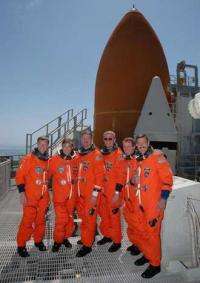
Atlantis team
With the final launch rehearsal completed, the STS-115 crew gathers on the 215-foot level of the fixed service structure on Launch Pad 39B. From left are Pilot Christopher Ferguson, Mission Specialists Heidemarie Stefanyshyn-Piper and Joseph Tanner, Commander Brent Jett, and Mission Specialists Steven MacLean and Daniel Burbank. Photo credit: NASA/Cory Huston

At a press conference late Wednesday, following the two-day flight readiness review at NASA's Kennedy Space Center in Florida, NASA's senior managers announced an Aug. 27 launch date for mission STS-115, resuming construction of the International Space Station.

NASA Administrator Michael Griffin said, "This was another great review and I'm looking forward to a great launch."

The Shuttle Mission Management Team conducts the review two weeks prior to the opening of the launch window for each space shuttle mission. The group conducts a comprehensive evaluation of all activities and elements necessary for the safe and successful performance of shuttle mission operations -- from the prelaunch phase through post-landing -- including the readiness of the vehicle, flight crew and payloads.

"We had a tremendous amount of discussion from all the folks involved, we covered a variety of topics. The challenge of the ISS assembly is really huge it is a very busy timeline. It really impressed me with how much the teams have prepared for this," said William Gerstenmaier, associate administrator for space operations.

The launch date is at the opening of the launch window, which extends until Sept. 13. NASA is once again limiting the launch to daylight hours to allow for extensive photography of the external tank during ascent.

"Team Atlantis is extremely happy to be at the launch pad and to have a date set. They are feeling really good right now," said NASA Launch Director Mike Leinbach.

With this mission, NASA is ready to get back to building the International Space Station, marking the first time in almost four years that a space station component has been added to the orbiting outpost. That also means the shuttle program is coming up on some of the most challenging space missions ever.

During three spacewalks, crew members of Atlantis will install the P3/P4 integrated truss and a second set of solar arrays on the space station, doubling the station’s current ability to generate power from sunlight and adding 17.5 tons to its mass.

Source: NASA

Explore further: Mice, gerbils perish in Russia space flight

add to favorites email to friend print save as pdf

Related Stories

NRL's MIGHTI slated for launch on ICON mission

18 hours ago

A Naval Research Laboratory (NRL) instrument designed to study the Earth's thermosphere is part of a satellite mission that NASA has selected to move forward into development (Phase B), with launch expected ...

Thermal shield testing on Webb's MIRI

May 09, 2013

(Phys.org) —NASA engineer Acey Herrera recently checked out copper test wires inside the thermal shield of the Mid-Infrared Instrument, known as MIRI, that will fly aboard NASA's James Webb Space Telescope. ...

Hot fire tests steer space launch system engines

Apr 23, 2013

(Phys.org) —Engineers developing NASA's next-generation rocket closed one chapter of testing with the completion of a J-2X engine test series on the A-2 test stand at the agency's Stennis Space Center in ...

Recommended for you

Mice, gerbils perish in Russia space flight

16 hours ago

A number of mice and eight gerbils sent into space in a Russian capsule destined to find out how well organisms can withstand extended flights perished during their journey, scientists said Sunday as the ...

Mars rover Opportunity examines clay clues in rock

May 18, 2013

(Phys.org) —NASA's senior Mars rover, Opportunity, is driving to a new study area after a dramatic finish to 20 months on "Cape York" with examination of a rock intensely altered by water.

NASA's STEREO detects a CME from the sun

May 17, 2013

On 5:24 a.m. EDT on May 17, 2013, the sun erupted with an Earth-directed coronal mass ejection or CME, a solar phenomenon that can send billions of tons of solar particles into space that can reach Earth ...

Nine-year-old Mars rover passes 40-year-old record

May 17, 2013

While Apollo 17 astronauts Eugene Cernan and Harrison Schmitt visited Earth's moon for three days in December 1972, they drove their mission's Lunar Roving Vehicle 19.3 nautical miles (22.210 statute miles ...

Bright explosion on the Moon

May 17, 2013

For the past 8 years, NASA astronomers have been monitoring the Moon for signs of explosions caused by meteoroids hitting the lunar surface. "Lunar meteor showers" have turned out to be more common than anyone ...

User comments : 0

More news stories

Heat-related deaths in Manhattan projected to rise

Residents of Manhattan will not just sweat harder from rising temperatures in the future, says a new study; many may die. Researchers say deaths linked to warming climate may rise some 20 percent by the 2020s, ...

Mice, gerbils perish in Russia space flight

A number of mice and eight gerbils sent into space in a Russian capsule destined to find out how well organisms can withstand extended flights perished during their journey, scientists said Sunday as the ...

Honeybees trained in Croatia to find land mines

(AP)—Mirjana Filipovic is still haunted by the land mine blast that killed her boyfriend and blew off her left leg while on a fishing trip nearly a decade ago. It happened in a field that was supposedly ...

Kinks and curves at the nanoscale

One of the basic principles of nanotechnology is that when you make things extremely small—one nanometer is about five atoms wide, 100,000 times smaller than the diameter of a human hair—they are going ...