Crab nabbed; circumstances fishy
Aug 10, 2006
Crab nabbed; circumstances fishy
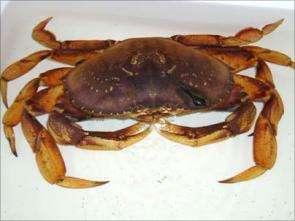
This Dungeness crab, a West Coast species, was caught by Captain Lou Williams of the Orin C two miles east of Thatcher Island, Massachusetts, on July 19. It's about 18 cm wide. Photo / Brandy Wilbur, MIT Sea Grant

MIT researchers have confirmed the first sighting of a Dungeness crab in the Atlantic Ocean. The male, whose species is common on North America's West Coast, was caught off Thatcher Island, Massachusetts, on July 19 by Lou Williams, captain of the fishing vessel Orin C.

The origin of the crab is not known. One possibility is that it may have been purchased from a live seafood market and released. The size of the crab (18 cm) and its gender suggest it most likely arrived as an adult exotic species. Also known as invasive species or bioinvaders, exotic species are of concern because they can establish themselves in a new ecosystem, where they can proliferate and push out native species.

The crab was caught while Williams was gillnetting for groundfish at 45 fathoms. Suspecting the crab to be a Dungeness, he took it to Brandy Wilbur, aquaculture specialist for MIT Sea Grant, and Eric Sabo, educator at the Gloucester Maritime Heritage Center, for verification.

After distributing photographs of the crab to several scientists, the researchers received confirmation of the species, Cancer magister, from several experts: Julie Barber, Massachusetts Division of Marine Fisheries; Thomas C. Shirley, Texas A&M University at Corpus Christi; David Tapley, Salem State College; and Richard Strathmann and Eugene Kozloff, the University of Washington's Friday Harbor Laboratories.

Judy Pederson, MIT Sea Grant's manager for coastal resources and an expert on marine invasives, says that the finding of a female crab would have raised greater concerns about the possibility of a marine bioinvasion. In the West Coast fishery for Dungeness crab, only males may be caught and sold. Pederson adds that the chance of two species of crabs cross mating is highly unlikely. However, she points out that the male crab could carry hitchhikers, such as native Pacific barnacles, or diseases that could harm native crustaceans, such as Jonah and rock crabs.

While the crab's method of entry is unknown, Pederson notes that the capture underscores the importance of not releasing any seafood into natural waters. In addition, MIT Sea Grant's Wilbur notes that this finding should put seafood distributors and fishermen on watch.

MIT Sea Grant will be producing and distributing "most wanted" posters to help those who might come across a Dungeness crab identify it and alert authorities.

Source: MIT

Explore further: Source of life running out: water scientists

add to favorites email to friend print save as pdf

Related Stories

Slow pokes: Acupuncture helps hypothermic turtles

May 21, 2013

Two endangered sea turtles that are shells of their former selves after getting stranded on Cape Cod during a cold spell are getting some help easing back into the wild—from an acupuncturist.

Why we need to put the fish back into fisheries

May 20, 2013

Overfishing has reduced fish populations and biodiversity across much of the world's oceans. In response, fisheries are increasingly reliant on a handful of highly valuable shellfish. However, new research by the University ...

Using sound to protect aquatic life

Apr 22, 2013

The large cargo ships that steam daily into Newark Bay unload more than the colorful containers stacked on deck - from their holds they also can release millions of gallons of water teeming with tiny sea creatures from faraway ...

Acidifying oceans may be harmful to porcelain crabs

Apr 08, 2013

(Phys.org) —As the world's oceans soak up carbon dioxide from an atmosphere increasingly polluted by fossil fuels, seawater will become more acidic. Two new studies by San Francisco State University students ...

Recommended for you

Source of life running out: water scientists

12 hours ago

The majority of people on Earth people will face severe water shortages within a generation or two if pollution and waste continues unabated, scientists warned at a conference in Bonn Friday.

Century-old science helps confirm global warming

May 23, 2013

(Phys.org) —Ocean measurements taken more than 135 years ago during the scientific expedition of HMS Challenger have provided further confirmation of human-produced global warming over the past century.

User comments : 0

More news stories

Galaxies fed by funnels of fuel

(Phys.org) —Computer simulations of galaxies growing over billions of years have revealed a likely scenario for how they feed: a cosmic version of swirly straws.

Dark, massive asteroid to fly by Earth on May 31

It's 1.7 miles long. Its surface is covered in a sticky black substance similar to the gunk at the bottom of a barbecue. If it impacted Earth it would probably result in global extinction. Good thing it is ...

Source of life running out: water scientists

The majority of people on Earth people will face severe water shortages within a generation or two if pollution and waste continues unabated, scientists warned at a conference in Bonn Friday.

Google eyes emerging markets networks

Google has become deeply involved in a series of projects to build and operate wireless networks in emerging markets including sub-Saharan Africa and Southeast Asia, a report said Friday.