August 1, 2006 feature
Search for Rare Particle Decay Comes Up Short
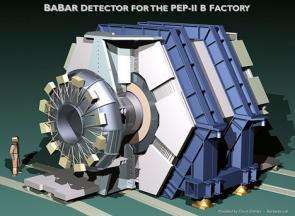
Based on work performed at a large particle detector known as the BaBaR experiment, scientists announced recently that they do not see evidence to support theoretical predictions that an extremely rare particle decay — the decay of the neutral “B” particle into a negative “tau” particle and its antiparticle, the positive tau — occurs often enough to be measured.
The search was initiated based on additions to the “Standard Model,” the broad physics theory that describes fundamental particles, how they interact, and how they bind together to form composite particles. The B particle, for example, is a member of a class of composite particles known as “mesons,” which consist of one quark — the “building block” of all other particles — and one antiquark. The tau, a fundamental, non-composite particle, can be thought of as a very heavy electron.
The original Standard Model allows the B meson to decay into the tau pair, but at a rate so low as to be extremely difficult to measure. However, recent proposed extensions to the model predict that the decay should occur at a measurable rate, perhaps through the addition of unknown forces or particles. Enter the BaBaR experiment.
Located at the Stanford Linear Accelerator Center (SLAC) near Stanford University, BaBaR was built, ultimately, to determine why matter dominates the present-day universe, with very little antimatter leftover from the Big Bang. The detector is positioned around one section of a very large particle accelerator, where a beam of electrons and a beam of anti-electrons — i.e. positrons — are directed in opposite circular paths at nearly the speed of light by a large ring of very powerful magnets.
The collisions produce B and anti-B mesons, which in turn decay into a shower of other particles. These particles pass into the BABAR detector, which records their trajectories, energies, and electric charge. From this data, scientists in the BABAR collaboration (about 600 physicists from more than 70 institutions worldwide) can work backward to determine how the B mesons decay.
“Our results show, at the 90 percent confidence level, that this decay occurs so infrequently as to be undetectable by BaBar. Our result is important because of what we did not find, since this places limits of possible new physics beyond the Standard Model,” said the experiment’s spokesperson, SLAC physicist David MacFarlane, to PhysOrg.com.
BaBar physicists analyzed the collisions by calculating the “branching ratio” for this particular decay. In essence, the size of this number tells them how often the decay occurs versus other possible decay paths for the B meson. The branching ratio for the neutral B-to-tau/anti-tau decay was determined to be — at the largest — 0.0041.
This research was published in the June 23, 2006, online edition of Physical Review Letters.
On the Net: www.slac.stanford.edu/BFROOT/
By Laura Mgrdichian, Copyright 2006 PhysOrg.com


