When robots learn social skills
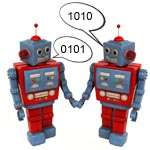
Learning to communicate and adapting our behaviour to the information we receive has been fundamental to human evolution. If machines could do the same the intelligent talking robots of science fiction could become the stuff of science reality, as researchers aim to prove.
Most research into the Artificial Intelligence (AI) that underpins any form of intelligent machine-machine or machine-human interaction has centred on programming the machine with a set of predefined rules. Researchers have, in effect, attempted to build robots or devices with the communication skills of a human adult. That is a shortcut that ignores the evolution of language and the skills gained from social interaction, thereby limiting the ability of AI devices to react to stimuli to within a fixed set of parameters.
But a team of researchers led by the Institute of Cognitive Science and Technology in Italy are taking a new approach to the problem, developing technology to allow machines to evolve their own language from their experiences of interacting with their environment and cooperating with other devices.
“The result is machines that evolve and develop by themselves without human intervention,” explains Stefano Nolfi, the coordinator the ECAgents project, which, with financing from the European Commission’s Future and Emerging Technologies (FET) initiative, has brought together researchers from disciplines as diverse as robotics, linguistics and biology.
Teaching a robotic dog new tricks
The technology, dubbed Embedded and Communicating Agents, has allowed researchers at Sony’s Computer Science Laboratory in France, for example, to add a new level of intelligence to the AIBO dog. Instead of teaching the dog new tricks, the algorithms, design principles and mechanisms developed by the project allow the robotic pet to learn new tricks itself and share its knowledge with others.
“What has been achieved at Sony shows that the technology gives the robot the ability to develop its own language with which to describe its environment and interact with other AIBOs – it sees a ball and it can tell another one where the ball is, if it’s moving and what colour it is, and the other is capable of recognising it,” Nolfi says.
The most important aspect, however, is how it learns to communicate and interact. Whereas we humans use the word ‘ball’ to refer to a ball, the AIBO dogs start from scratch to develop common agreement on a word to use to refer the ball. They also develop the language structures to express, for instance, that the ball is rolling to the left. This, the researchers achieved through instilling their robots with a sense of ‘curiosity.’
Initially programmed to merely recognise stimuli from their sensors, the AIBOs learnt to distinguish between objects and how to interact with them over the course of several hours or days. The curiosity system, or ‘metabrain,’ continually forced the AIBOs to look for new and more challenging tasks, and to give up on activities that did not appear to lead anywhere. This in turn led them to learn how to perform more complex tasks – an indication of an open-ended learning capability much like that of human children.
And also like children the AIBOs initially started babbling aimlessly until two or more settled on a sound to describe an object or aspect of their environment, thus gradually building a lexicon and grammatical rules through which to communicate.
“This is not only important from a robotics and AI perspective, it could also help us understand how language systems arise in humans and animals,” Nolfi notes.
With applications elsewhere
The success of the evolutionary and social learning approach taken to developing AI by the project has also been demonstrated in other trials.
In tests run at the Swiss Federal Institute of Technology in Lausanne hordes of small wheeled robots learnt how to communicate, cooperate and self-organise to perform tasks that would be too complicated for a single robot.
“The technology could lead to robots able to carry out rescue operations by swarming over inaccessible areas to find people,” Nolfi says.
Another project partner, the Viktoria Institute in Sweden, has used Embodied and Communicating Agents to develop a system called Push!Music that provides a new and innovative way to share music files over portable devices. Instead of users having to search for files for their mobile phone or MP3 player, Push!Music automatically shares files between users wirelessly as they sit in a café or pass in the street. AI decides what tracks to exchange based on the user’s preferences and listening habits.
“From a communications perspective this is interesting because it shows how different devices can be made to find ways to understand each other and their users,” says Nolfi.
A similar application could be applied to the internet, where intelligent software agents could be used to intuitively search and categorise information depending on users’ interests and needs.
It is in portable devices and the internet where Nolfi sees the first applications for the technology arising, although he also believes it is probable it will lead to the first robots that are really able to learn, communicate and adapt to their environment within a few years.
“This is a project with a big impact. We’ve managed to ground AI in reality, in the real world, solving one of the crucial problems to creating truly intelligent and cooperative systems,” he says.
Source: IST Results


