The Magnetic Nature of a Mysterious Cosmic X-ray Emitter
Our Sun has its explosive flares and spots and high speed wind, but it is a placid star compared to some. Stars that are much more massive live fast and die young, with blue-white, intensely hot surfaces that emit energy at a rate millions of times greater than that of the Sun. These stars are so bright that their light alone propels outflowing stellar winds - up to a billion times stronger than the solar wind - at speeds of up to 30,000 km/s, or one per cent of the speed of light.
An international team of astronomers has discovered that one such star, the naked-eye tau Scorpii, unexpectedly hosts a complex network of magnetic field lines over its surface. Tau Scorpii has been known for some time to emit X-rays at an unusually high rate and to rotate slower than most otherwise similar stars. The newly discovered magnetic field, presumably a relic from the star’s formation stage, goes some way to explaining both characteristics, although the mechanism by which the magnetic field slowed down tau Scorpii's rotation so strongly remains mysterious.
These results will be published in the Monthly Notices of the Royal Astronomical Society.
The processes by which hot, massive stars expel their surface layers through their strong outflowing winds have a major impact on a star's long-term fate. The cast-off material can also interact with other nearby stars, contribute matter and energy to the surrounding interstellar medium, and even induce bursts of new star formation. Hot massive stars are thus key actors in the life of a galaxy.
One such hot star is tau Scorpii, whose intrinsic brightness is so great that it is easily visible with the naked eye, despite its distance of over 400 light-years. Weighing as much as 15 Suns, tau Scorpii is 5 to 6 times bigger and hotter than our own star. Such massive stars are relatively few in number compared to stars like the Sun, and tau Scorpii is actually one of our closest massive neighbours.
Massive stars are thought to emit X-rays because of supersonic shocks occurring within their outflowing winds. However, tau Scorpii is an unusually strong X-ray source compared to stars which are otherwise similar.
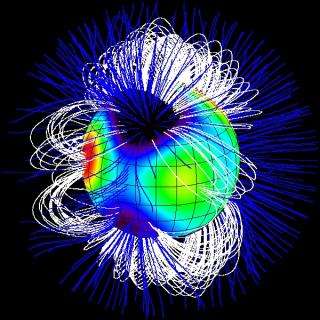
The reason for this enhanced activity was a puzzle until the present discovery, which revealed that the star hosts a complex network of magnetic field lines over its surface (see image). According to the discovery team, this field is most probably a relic from the star's formation stage.
The most interesting aspect, though, is how the field interacts with the wind, forcing it to flow along magnetic field lines, like beads along wires. Wind streams along 'open' magnetic field lines (shown in blue) freely escape the star, something that wind streams in magnetic 'arcades' (shown in white) cannot achieve. The result is that, within each magnetic arcade, wind flows from both footprints collide with each other at the loop summits, producing tremendously energetic shocks and turning the wind material into blobs of million-degree, X-ray emitting plasma tied to the magnetic loops.
This model provides a natural explanation of why tau Scorpii is such an intense X-ray emitter. However, it is not yet clear how the magnetic field succeeded in slowing down the rotation rate of the star to less than one-tenth that of otherwise similar, non-magnetic, massive stars.
Sun-like stars can be slowed down through their magnetic wind, just as ice-skaters are spun down when outstretching their arms. Tau Scorpii does not, however, lose material fast enough to have its rotation modified within its very short lifetime of a few million years.
The researchers discovered and examined the magnetic field of the star by looking at the tiny, very specific polarisation signals that magnetic fields induce in the light of magnetic stars. To do this, they used ESPaDOnS, by far the most powerful instrument in the world for carrying out this kind of research. This new instrument, currently attached to the Canada-France-Hawaii Telescope on Hawaii, was specially designed at the Observatoire Midi-Pyrénées in France for observing and studying magnetic fields in stars other than the Sun.
Source: Royal Astronomical Society


