Discovery scheduled for important move
May 01, 2006
Space Shuttle Discovery

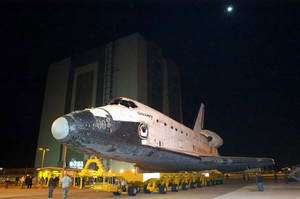
NASA officials say an important milestone for the upcoming Space Shuttle Discovery mission will occur May 12, when the shuttle is moved from its hangar.

The move from the Orbiter Processing Facility to the Vehicle Assembly Building at the Kennedy Space Center is known as the rollover. Inside the assembly building, Discovery will be attached to a redesigned external fuel tank and twin solid rocket boosters.

Discovery's launch is set for July 1, with a launch window that extends to July 19.

During its 12-day mission to the International Space Station, Discovery's crew of seven will test new hardware and techniques to improve shuttle safety, as well as deliver supplies to the station.

Copyright 2006 by United Press International

Explore further: Mice, gerbils perish in Russia space flight

add to favorites email to friend print save as pdf

Related Stories

Neural activity in bats measured in-flight

Apr 18, 2013

Animals navigate and orient themselves to survive – to find food and shelter or avoid predators, for example. Research conducted by Dr. Nachum Ulanovsky and research student Michael Yartsev of the Weizmann ...

Scripps vessel named for Sally Ride

Apr 17, 2013

U.S. Secretary of the Navy Ray Mabus announced the nation's newest research vessel will be named R/V Sally Ride, in honor of the former UC San Diego faculty member who was the first American female astronaut and the youngest ...

Recommended for you

Mice, gerbils perish in Russia space flight

4 hours ago

A number of mice and eight gerbils sent into space in a Russian capsule destined to find out how well organisms can withstand extended flights perished during their journey, scientists said Sunday as the ...

Mars rover Opportunity examines clay clues in rock

May 18, 2013

(Phys.org) —NASA's senior Mars rover, Opportunity, is driving to a new study area after a dramatic finish to 20 months on "Cape York" with examination of a rock intensely altered by water.

NASA's STEREO detects a CME from the sun

May 17, 2013

On 5:24 a.m. EDT on May 17, 2013, the sun erupted with an Earth-directed coronal mass ejection or CME, a solar phenomenon that can send billions of tons of solar particles into space that can reach Earth ...

Nine-year-old Mars rover passes 40-year-old record

May 17, 2013

While Apollo 17 astronauts Eugene Cernan and Harrison Schmitt visited Earth's moon for three days in December 1972, they drove their mission's Lunar Roving Vehicle 19.3 nautical miles (22.210 statute miles ...

Bright explosion on the Moon

May 17, 2013

For the past 8 years, NASA astronomers have been monitoring the Moon for signs of explosions caused by meteoroids hitting the lunar surface. "Lunar meteor showers" have turned out to be more common than anyone ...

User comments : 0

More news stories

Mice, gerbils perish in Russia space flight

A number of mice and eight gerbils sent into space in a Russian capsule destined to find out how well organisms can withstand extended flights perished during their journey, scientists said Sunday as the ...

Fracking risks to ground water assessed

(Phys.org) —Extraction of "unconventional" gas from sedimentary rocks such as shale could provide a clean energy source and help some regions to become energy independent, but concerns have been raised ...

Kinks and curves at the nanoscale

One of the basic principles of nanotechnology is that when you make things extremely small—one nanometer is about five atoms wide, 100,000 times smaller than the diameter of a human hair—they are going ...

Honeybees trained in Croatia to find land mines

(AP)—Mirjana Filipovic is still haunted by the land mine blast that killed her boyfriend and blew off her left leg while on a fishing trip nearly a decade ago. It happened in a field that was supposedly ...

German energy shift faces headwinds

Tense engineers have their eyes peeled on complex colour-coded diagrams on a wall-sized screen that makes their control room look like the inside of a spaceship.