Formation of cellulose fibers tracked for the first time
Apr 20, 2006
Formation of cellulose fibers tracked for the first time
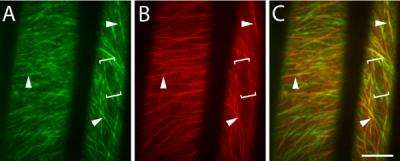
Molecules of cellulose synthase, the enzyme that produces cellulose, follow microtubule “tracks” in growing plant cells. Each image in this set consists of 30 frames, taken at 10 second intervals, laid on top of one another to track the motion of fluorescent molecules. Cellulose synthase (green, panel A) and tubulin, the protein that makes up microtubules (red, panel B), are highly correlated, especially in the areas marked with arrows. Very little of either molecule is found inside the area marked with brackets. The third image (panel C) shows both panels superimposed on each other. (Image used with permission of the American Association for the Advancement of Science, Science Express, April 20, 2006 online issue)

Cellulose--a fibrous molecule found in all plants--is the most abundant biological material on Earth. It is also a favored target of renewable, plant-based biofuels research. Despite overwhelming interest, scientists know relatively little about how plant cells synthesize individual cellulose fibers.

However, recent work from the Carnegie Institution's Department of Plant Biology and Stanford University describes the first real-time observations of cellulose fiber formation. The research, published in the April 20 online issue of Science Express, provides the first clear evidence for a functional connection between synthesis of the cell wall and an array of protein fibers--called microtubules--that help to shape growing plant cells from the inside.

"The more we understand about cellulose, the easier it will be to modify it," said Chris Somerville, director of the Carnegie department. "With this knowledge, we are one step closer to designing energy-rich biofuel crops and improved fiber crops."

Cellulose fibers make up a significant portion of the dry weight of most plants. Because the fibers can be broken down into the sugar glucose, which can then be converted into ethanol and other biofuels, there are huge incentives to learn more about how plants produce and modify the molecule. Cellulose is also the main constituent of cotton, paper, wood, and animal feeds such as hay.

Somerville, along with colleague David Ehrhardt and Stanford graduate student Alex Paredez, engineered plants to produce a fluorescent version of cellulose synthase, the enzyme that creates cellulose fibers. They also included a fluorescent version of tubulin, the protein from which microtubules are built. Using an imaging technique that can track the motion of single fluorescent molecules, the researchers found that cellulose synthase moves along "tracks" defined by the microtubules. When the microtubule tracks were disrupted with specific drugs, the cellulose synthase molecules kept moving, but they followed different, less directed patterns.

"Many scientists had suspected a relationship between cellulose synthase and microtubules, but the exact nature of the interaction was hard to pinpoint," Ehrhardt said. "The microtubules act as more than a general scaffold for organizing the cell wall; individual elements of the microtubule array appear to actively direct the pattern of the cellulose fibers. This work should set a long-standing discussion to rest."

Source: Carnegie Institution

Explore further: US economy: Steady as she goes

add to favorites email to friend print save as pdf

Related Stories

Advance in understanding cellulose synthesis

Jun 14, 2009

Cellulose is a fibrous molecule that makes up plant cell walls, gives plants shape and form and is a target of renewable, plant-based biofuels research. But how it forms, and thus how it can be modified to design energy-rich ...

Recommended for you

Prehistoric rock art maps cosmological belief

2 hours ago

It is likely some of the most widespread and oldest art in the United States. Pieces of rock art dot the Appalachian Mountains, and research by University of Tennessee, Knoxville, anthropology professor Jan ...

'Ugly' finding: Unattractive workers suffer more

5 hours ago

People who are considered unattractive are more likely to be belittled and bullied in the workplace, according to a first-of-its-kind study led by a Michigan State University business scholar.

Taking stock of technology

5 hours ago

At the recent Harvard IT Summit, Anne Margulies, vice president and University chief information officer, mentioned how Harvard had been at the forefront of information technology since its inception, even to the point of ...

Gay marriage ruling unlikely to cause anti-gay backlash

6 hours ago

Concerns that a U.S. Supreme Court ruling favorable to gay marriage might produce a backlash that would impede efforts to achieve equality are unfounded, according to a study by researchers at University of California campuses ...

User comments : 0

More news stories

Prehistoric rock art maps cosmological belief

It is likely some of the most widespread and oldest art in the United States. Pieces of rock art dot the Appalachian Mountains, and research by University of Tennessee, Knoxville, anthropology professor Jan ...

'Ugly' finding: Unattractive workers suffer more

People who are considered unattractive are more likely to be belittled and bullied in the workplace, according to a first-of-its-kind study led by a Michigan State University business scholar.

The hidden agenda of Obama's opposition

Is the US Tea Party movement a racial backlash against President Obama? A new study by Angie Maxwell from the University of Arkansas, and Wayne Parent from Louisiana State University, assesses whether racial attitudes are ...

Metamorphosis of moon's water ice explained

Using data gathered by NASA's Lunar Reconnaissance Orbiter (LRO) mission, scientists believe they have solved a mystery from one of the solar system's coldest regions—a permanently shadowed crater on the ...