Measuring Electrical Arcs At the Micrometer Scale
Air is a great insulator—except when it becomes a conductor. Under the right conditions, miniature lightning bolts of electricity will “arc” through the air between two electrically conducting points. Engineers can accurately predict how this happens on the macroscopic scale—when electricity from a downed power line, for example, jumps to a nearby metal object—but less is known about the process at the micro scale.
To help quantify the process, a new device and technique have been developed at the National Institute of Standards and Technology (NIST) for measuring “breakdown” voltage—the voltage required to produce electrical arcs when electrodes are 400 nanometers to 45 micrometers apart. The advance could be useful in microelectronics, such as in the design of microelectro-mechanical systems (MEMS), in which arcing could cause device failure. The NIST work may also be useful in the design of larger scale electrical systems for automobiles.
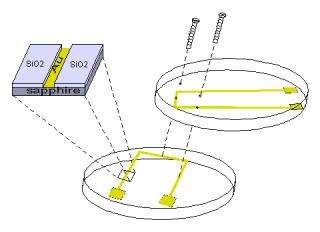
The device (a novel capacitor design), described in the March issue of Review of Scientific Instruments, includes two horseshoe-shaped circuits that each end in two smooth rectangular electrodes. The distance between electrodes of different circuits can be varied in micrometer increments. To determine the breakdown voltage for each distance, the researchers changed the amount of voltage applied and measured the resulting current flowing between the two electrodes. For example, NIST researchers found that, at an electrode separation of 7 micrometers, the breakdown voltage is 185 volts. Conventional wisdom for electrical behavior at the macroscale says that at least 360 volts are needed.
Air insulates at low electric fields because electrons are scattered by nitrogen and oxygen atoms, thereby slowing them down. But at higher fields, the electrons gain enough energy to knock additional electrons out of the molecules in the air, and a current can form. Electrode shape is also a factor; sharp points produce electric fields that vary with position, and are therefore more likely to cause problems than blunt shapes. The NIST capacitor enables very accurate measurements because it produces nearly parallel electric fields and has very smooth electrodes made of thin films of gold only 70 nm thick (even slight surface roughness amplifies electric fields).
Citation: E. Hourdakis, B.J. Simonds, and N.M. Zimmerman. 2006. Sub-micron gap capacitor for measurement of breakdown voltage in air. Review of Scientific Instruments. March.
Source: NIST


