Robots That Act Like Rats
Robots that act like rat pups can tell us something about the behavior of both, according to UC Davis researchers.
Sanjay Joshi, assistant professor of mechanical and aeronautical engineering, and associate professor of psychology Jeffrey Schank have recorded the behavior of rat pups and built rat-like robots with the same basic senses and motor skills to see how behavior can emerge from a simple set of rules.
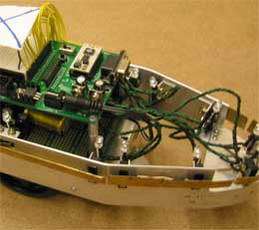
Image: This robot was designed with the same basic senses and motor skills as a rat pup. (Sanjay Joshi/UC Davis photo)
Seven to 10-day-old rat pups, blind and deaf, do not seem to do a whole lot. Videotaped in a rectangular arena in Schank's laboratory, they move about until they hit a wall, feel their way along the wall until their nose goes into a corner, then mostly stay put. Because their senses and responses are so limited, pups should be a good starting point for building robots that can do the same thing.
Joshi's laboratory built foot-long robots with tapered snouts, about the same shape as a rat pup. The robots are ringed by sensors so that they "feel" when they bump into a wall or corner. They are programmed to stay in contact with objects they touch, as rats do.
But when the robotic "rats" were put into a rectangular arena like that used for experiments with real rats, the robots showed a new behavior. They scuttled along the walls and repeatedly bumped into one corner, but favored one wall. Instead of stopping in a corner they kept going, circling the arena.
"When we re-analyzed the animal data, we found that the animals were also favoring one wall over another as they bumped around in corners," Joshi said. "The robots showed us what to look for in animal studies."
The wall-following or corner-sticking is emergent behavior, he said. That means it is not written into the computer code, but emerges as a result of the instructions the robot follows as it interacts with the environment at each instant.
The team is also looking at the behavior that emerges when groups of robotic rats interact using different kinds of rules. This should show biologists what the rats may be doing. Understanding the biology of these simple systems might later inform the design of more sophisticated robots, Joshi said.
Source: University of California - Davis


