Clues included in diamonds
Oct 07, 2010
Clues included in diamonds
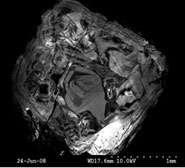
Cathodoluminescence image showing complex growth zones of a deep mantle diamond with majorite garnet inclusions from Juina, Brazil

A study of Brazilian diamonds by Earth scientists from the University of Bristol has found that tiny inclusions in the diamonds contain traces of oceanic crust and sedimentary rocks, formed originally on the surface of the Earth then transported to depths of more than 300km.

The plate tectonic process of subduction transports materials from Earth’s outermost layers to the deep interior, hundreds of kilometres below our feet. Traces of these deeply subducted materials can be imaged remotely by seismology or geochemistry. However, sampling them directly is very difficult – the deepest hole ever drilled is a mere 12.2 km, and yet the centre of Earth is 6,400 km away.

As a result, our only direct insights into Earth materials below about 200 km depth come from .  Whilst most diamonds are valued for their clarity and purity, rarely they contain tiny inclusions of minerals, trapped when the diamond grew.

University of Bristol Earth scientists Galina Bulanova, Michael Walter, Chris Smith, Lora Armstrong, Simon Kohn, and Jon Blundy have been studying these tiny inclusions, less than a hair’s breadth across, from diamonds in the Juina region of central Brazil.

Remarkably they found traces of oceanic crust and formed originally on the ’s surface, prior to being transported to depths of some 300-700 km.  The diamonds and their inclusions were swept up in a plume of hot rock, responsible for magmatism across central Brazil almost 100 million years ago.

The results, published this week in the journal Contributions to Mineralogy and Petrology (vol. 160, p. 489), are the culmination of a truly interdisciplinary study using an array of spectroscopy, electron- and ion-microbeam techniques, stable isotope geochemistry and high pressure experimentation.


Explore further: Researchers map historic sea-level change on the New Jersey coastline

More information: Mineral inclusions in sublithospheric diamonds from Collier 4 kimberlite pipe, Juina, Brazil: subducted protoliths, carbonated melts and primary kimberlite magmatism by Galina P. Bulanova, et al, in Contributions to Mineralogy and Petrology.

add to favorites email to friend print save as pdf

Related Stories

Meteorite yields carbon crystals harder than diamond

Feb 03, 2010

(PhysOrg.com) -- Two new types of ultra-hard carbon crystals have been found by researchers investigating the ureilite class Haverö meteorite that crashed to Earth in Finland in 1971. Ureilite meteorites ...

Bias in the rock record?

Jan 14, 2009

(PhysOrg.com) -- The fossil record is known to be biased by the unevenness of geographical and stratigraphical sampling, and the lack of exposed rocks containing fossils. In a recent Perspective in Science [2 Jan ...

Scientists' work improves odds of finding diamonds

Jul 14, 2010

While prospectors and geologists have been successful in finding diamonds through diligent searching, one University of Houston professor and his team's work could help improve the odds by focusing future searches in particular ...

Diamond is one tough cookie

Jan 26, 2010

(PhysOrg.com) -- Most people know that diamond is one of the hardest solids on Earth, so strong that it can easily cut through glass and steel. Surprisingly, very little is known about the strength of diamond ...

Recommended for you

Bacterium from Canadian High Arctic and life on Mars

11 minutes ago

(Phys.org) —The temperature in the permafrost on Ellesmere Island in the Canadian high Arctic is nearly as cold as that of the surface of Mars. So the recent discovery by a McGill University led team of ...

NASA's Landsat satellite looks for a cloud-free view

15 hours ago

For decades, Landsat satellites have documented the desiccation of the Aral Sea in Central Asia. Once one of the largest seas in the world, it shrunk to a tenth of its original volume after Russia diverted ...

Volcanoes cause climate gas concentrations to vary

23 hours ago

Trace gases and aerosols are major factors influencing the climate. With the help of highly complex installations, such as MIPAS on board of the ENVISAT satellite, researchers try to better understand the ...

User comments : 0

More news stories

Very Large Telescope celebrates 15 years of success

(Phys.org) —With this new view of a spectacular stellar nursery ESO is celebrating 15 years of the Very Large Telescope—the world's most advanced optical instrument. This picture reveals thick clumps ...

Be prepared for weather extremes

Unsettled weather is an Iowa mainstay, and so is Inside's annual reminder of the university's severe weather safety and preparedness guidelines—for storms, extreme heat, flooding and more.

Weird science: Crystals melt when they're cooled

(Phys.org) —Growing thin films out of nanoparticles in ordered, crystalline sheets, to make anything from microelectronic components to solar cells, would be a boon for materials researchers, but the physics ...

Unlocking secrets of cell reproduction

Research published in Open Biology today identifies, for the first time, nearly all the genes required for reproduction of a cell in a living organism.