Web founder warns of Internet disconnect law 'blight'
Sep 28, 2010
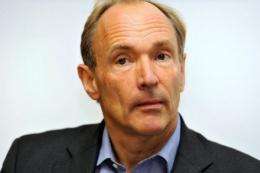
British computer scientist Tim Berners-Lee, who is credited with inventing the World Wide Web, discusses web science during a press conference at The Royal Society in London. Berners-Lee warned Tuesday of the "blight" of new laws being introduced across the globe allowing people to be cut off from the Internet.

Tim Berners-Lee, the man credited with inventing the world wide web, warned Tuesday of the "blight" of new laws being introduced across the globe allowing people to be cut off from the Internet.

"There's been a rash of laws trying to give governments and Internet service providers (ISPs) the right and the duty to disconnect people," he told a conference on science at the Royal Society in London.

The "current blight" includes a French law that comes into effect this year that threatens to cut people off if they illegally download from the Internet, and a new British law passed in April which could see similar action, he said.

"If a French family can be forcibly disconnected from the Internet by for a year because one of their children downloaded something that some company asserts that they should not have downloaded, without trial -- I think that's a kind of inappropriate punishment," Berners-Lee said.

He added: "I'd like to go on using the Internet. If it gets cut off, or for some reason things go wrong, in some cases, for me, my social life would disintegrate, for other people it may be access to medical information."

The Massachusetts Institute of Technology (MIT) professor said the US Senate was also considering a bill this week that would have the government create a blacklist of Internet sites that US ISPs would be required to block.

Twenty years after his breakthrough while working at CERN, the European particle physics laboratory, Berners-Lee said "the net has got to a point that is so critical".

Given the importance of the web in everyone's lives, he urged the Internet experts gathered at the conference to act on the encroachment of the once free-for-all online world. "We have this duty of care," he said.

While Berners-Lee said ISPs should not in general be responsble for the content they were carrying, he admitted that issues of anti-terrorism and serious organised crime were "an exception".

Explore further: Review: Google music plan solid, serendipitous

add to favorites email to friend print save as pdf

Related Stories

Draper prize to go to MIT researcher

Jan 15, 2007

A Massachusetts Institute of Technology researcher credited with inventing the World Wide Web is the winner of the 2007 Charles Stark Draper Prize.

Web founder makes online privacy plea

Apr 22, 2009

Plans by Internet service providers to deliver targeted adverts to consumers based on their Web searches threaten online privacy and should be opposed, the founder of the Web said Wednesday.

Web founder fears 'snooping' on the Internet

Mar 13, 2009

Tim Berners-Lee, one of the founders of the World Wide Web, said Friday that he was concerned about the emergence of user profiling on the Internet and "snooping."

Internet has only just begun, say founders

Apr 22, 2009

While the Internet has dramatically changed lives around the world, its full impact will only be realised when far more people and information go on-line, its founders said Wednesday.

Recommended for you

Review: Google music plan solid, serendipitous

8 hours ago

Google's new music service offers a lot of eye candy to go with the tunes. The song selection of around 18 million tracks is comparable to popular services such as Spotify and Rhapsody, and a myriad of playlists ...

Facebook joins Web freedom group

May 22, 2013

Facebook on Wednesday became a full member of the Global Network Initiative, a non-governmental organization promoting Internet freedom and privacy rights.

Big Data—for better or worse

May 22, 2013

A full 90% of all the data in the world has been generated over the last two years. The internet companies are awash with data that can be grouped and utilised. Is this a good thing?

User comments : 0

More news stories

Google Drive sports new view and scan enhancements

(Phys.org) —Google Drive has a new look and functions. The makeover in Google Drive features scanning and interface enhancements that put the user into "card" mode. The enhancements make it easy for the ...

Solar Kettle allows for boiling water off the grid

(Phys.org) —A company called Contemporary Energy has unveiled a new device it calls the Solar Kettle. It looks very much like a normal coffee thermos, but has flaps on one side that open to allow for collecting ...

Review: Google music plan solid, serendipitous

Google's new music service offers a lot of eye candy to go with the tunes. The song selection of around 18 million tracks is comparable to popular services such as Spotify and Rhapsody, and a myriad of playlists ...

Controlling mood through the motions of mitochondria

(Medical Xpress)—Regulating the distribution of power in neurons is done by a system that makes the national electric grid look simple by comparison. Each neuron has several thousand mitochondria confined ...

A quantum simulator for magnetic materials

Physicists understand perfectly well why a fridge magnet sticks to certain metallic surfaces. But there are more exotic forms of magnetism whose properties remain unclear, despite decades of intense research. ...