Rotating high-pressure sodium lamps provide flowering plants for spring markets
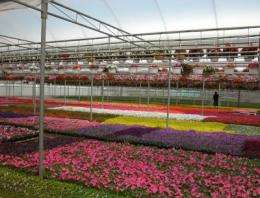
When consumers visit garden centers in spring they will most likely buy flowering ornamental plants that are ready for their home gardens. Studies have shown that consumers favor plants that are already in flower rather than those that are "vegetative"—a preference that can present multiple challenges for commercial growers.
To satisfy consumers' wishes, producers of ready-to-flower ornamentals like bedding plants and perennials start growing crops far in advance of the spring buying season, often during the dark and short days of winter. When the days are short, commercial growers turn to "light manipulation" techniques that either promote or prevent flowering in preparation for delivery to markets. New research from a team at Michigan State University offers commercial plant producers a cost-effective method for producing market-ready plants that appeal to both consumers and retailers.
"Long-day" plants are varieties in which flowering is promoted under short periods of darkness, whereas "short-day" plants flower when the dark period exceeds a critical duration. To satisfy spring markets, some commercial ornamental growers create artificial long-day (LD) environments to produce flowering plants for delivery to retailers. Growers employ several methods to promote flowering in LD plants under natural short photoperiods. Methods include extending day length with artificial lighting, shortening the period of darkness by providing night-interruption (NI) lighting, or using cyclic or intermittent lighting during which incandescent lamps are turned on and off at specific intervals for a certain duration.
Matthew G. Blanchard and Erik S. Runkle from the Department of Horticulture at Michigan State designed an experiment to evaluate a technology for long-day lighting for commercial production of ornamentals. The experiment used four popular flowering ornamentals (campanula, coreopsis, petunia, and rudbeckia) to compare the efficacy of a rotating high-pressure sodium lamp (HPS) in promoting flowering with night-interruption lighting using incandescent lamps.
Seedlings were grown under natural short-day photoperiods (12 hours or less) and night-interruption treatments were delivered from a rotating HPS lamp mounted at one gable end of the greenhouse or from incandescent lamps that were illuminated continuously for four hours or cyclically for 6 minutes every 30 minutes for 4 hours. Within 16 weeks, 80% or more of the plants of each species that received night-interruption lighting had a visible flower bud or inflorescence; all species but petunia remained vegetative under the short-day treatment. Flowering of all species grown at 13 meters from the rotating HPS lamp was delayed by 14 to 31 days compared with those under continuous incandescent illumination.
The researchers estimated that the weekly cost to operate night-interruption lighting was an impressive 80% to 83% less than the cost of continuous incandescent lighting. According to Blanchard and Runkle, "a rotating HPS lamp operated continuously during a 4-hour night-interruption was effective at promoting flowering in these long-day species and consumed less energy compared with incandescent lamps operated continuously." The researchers concluded that use of rotating high-pressure sodium lamps could be effective in commercial production as long as the light intensity is above the recommended value.
More information: The complete study and abstract are available on the ASHS HortScience electronic journal web site: hortsci.ashspublications.org/c … nt/abstract/45/2/236
Provided by American Society for Horticultural Science


