Scientists urge halt to road through Serengeti
Sep 17, 2010 by Lin Edwards report
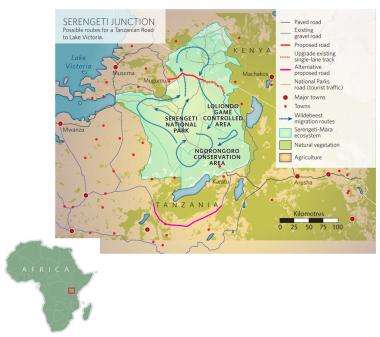
Image credit: Nature, doi:10.1038/467272a

(PhysOrg.com) -- Scientists have appealed for a halt to plans to build a road through the Serengeti National Park in Tanzania in 2012, saying it will be an environmental disaster.

A group of 27 scientists, reporting in the journal Nature yesterday, say the proposed two-lane 50 km through the northern end of the would curtail the migration of wildebeest, and according to their computer simulation, this would cause a collapse in what is the largest migratory system on Earth, and could lead to a drop in the wilderbeest population from 1.3 million to under 300,000. It would also affect the annual migration of 1.5 million zebras in the park, and have knock-on effects on the ecosystems.

The road would be used by vehicles carrying goods, including herbicides, pesticides, and seeds of potentially . The scientists say it would be a source of chemical pollutants such as lead and other that would flow into waterways in high concentrations in the rainy season. They say a road dividing the park would also make life easier for poachers, and would increase human conflicts with the animals in the park.

The planned road is to form part of links between the coast of Tanzania and Uganda, Rwanda, Burundi, Lake Victoria, and the , and there has been growing pressure to build a road to facilitate commerce and trade in the region.

The scientists, led by Andrew Dobson of Princeton University, propose an alternative route running to the south of the park, which they say will bring greater benefits to the environment and development without threatening the wildebeest population or the tourist industry, which supports thousands of people. If built in the south the road would need to be longer, but would be less expensive, and would also serve almost five times as many people as the planned route through the north.

Nature cautioned in an editorial that the current proposal is for a gravel road and the predictions are based on a fenced tarmac road, which the scientists say would probably follow. The journal also cautioned that criticisms from foreigners could have a negative backlash or cause entrenchment of attitudes.

Explore further: Obama vows US 'will do more' to battle climate change

More information: Road will ruin Serengeti, Nature 467, 272-273 (16 September 2010) doi:10.1038/467272a ; Published online 15 September 2010

Related Stories

DR Congo hippos face extinction

Sep 13, 2005

Hippopotamuses living in the Virunga National Park in the Democratic Republic of Congo reportedly are facing extinction.

Penn State to recycle tires into roads

Apr 07, 2006

Penn State's Center for Dirt and Gravel Road Studies received a $696,685 grant from the Pennsylvania Department of Environmental Protection to use waste tires to improve dirt roads that are causing silting of local waterways. ...

Recommended for you

Singapore haze at worst yet, Malaysia schools shut

14 minutes ago

Singapore urged people to remain indoors amid unprecedented levels of air pollution Thursday as a smoky haze wrought by forest fires in neighboring Indonesia worsened dramatically. Nearby Malaysia closed ...

Philippines financial capital bans plastic bags

34 minutes ago

The Philippines financial capital banned disposable plastic shopping bags and styrofoam food containers on Thursday, as part of escalating efforts across the nation's capital to curb rubbish that exacerbates ...

Looking at sachet water consumption in Ghana

11 hours ago

Many of West Africa's largest cities continue to lag in their provision of piped water to residents. Filling the service gap are plastic water sachets, which have become an important source of drinking water ...

Indonesia to use rain-making technology to stop fires

21 hours ago

Indonesia plans to use weather changing technology to try to unleash torrents of rain and extinguish raging fires on Sumatra island that have cloaked neighbouring Singapore in thick haze, an official said ...

User comments : 1

Adjust slider to filter visible comments by rank

Display comments: newest first

omatumr
3.2 / 5 (5) Sep 17, 2010
Let's hope that these scientists based their opinions on scientific facts, and not on the whims of a politician who has learned to use science as a propaganda tool.

And let's hope that the Nature editor, Dr. Philip Campbell, published it solely on the basis of its scientific merits.

With kind regards,
Oliver K. Manuel
Former NASA Principal
Investigator for Apollo

More news stories

Philippines financial capital bans plastic bags

The Philippines financial capital banned disposable plastic shopping bags and styrofoam food containers on Thursday, as part of escalating efforts across the nation's capital to curb rubbish that exacerbates ...

Singapore haze at worst yet, Malaysia schools shut

Singapore urged people to remain indoors amid unprecedented levels of air pollution Thursday as a smoky haze wrought by forest fires in neighboring Indonesia worsened dramatically. Nearby Malaysia closed ...

China astronauts float water blob in kids' lecture

Astronauts struck floating martial arts poses, twirled gyroscopes and manipulated wobbling globes of water during a lecture Thursday from China's orbiting space station that's part of efforts to popularize ...

Panic over MERS virus fades in Saudi

People in Saudi Arabia's Eastern Province have again started greeting friends with the traditional kiss on the cheek, and face masks in public are becoming rarer, as panic subsides over the outbreak of a deadly respiratory ...

Sony chief says time needed to study proposal

Sony Corp. needs more time to study a key proposal from a U.S. hedge fund to spin off a part of its entertainment unit as a way to propel its fledgling revival, the chief executive told shareholders Thursday.

French firemen test hypnosis to help victims

"Look me straight in the eye. Your mind is emptying, your body is relaxing," says the fireman, using the calming words of hypnosis to help a trauma victim—a technique being pioneered by fire crews in the eastern French ...

Danish chemists in molecular chip breakthrough

Electronic components built from single molecules using chemical synthesis could pave the way for smaller, faster and more green and sustainable electronic devices. Now for the first time, a transistor made ...