Taiwan turns plastic junk to 'green' gold
Sep 13, 2010 by Amber Wang
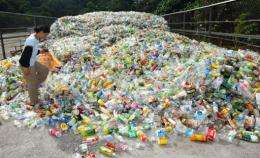
Recycling station operated by Tzu Chi Foundation is pictured in Taipei. Environmentally conscious Taiwan is tapping into the market of recycled plastics to build exhibition halls, make clothes and other items in an industry with an estimated annual worth of $140 million.

The mountains of used plastic bottles at a recycling station in Taipei emit a faint smell of garbage dump, but soon they will be turned into wigs and clothes that people will wear.

From fake hair to football jerseys and building bricks, Taiwan is breathing new life into its massive plastics waste, creating a booming new business at the same time as it aims to go green.

The island started recycling plastic more than a decade ago amid growing environmental concerns, and today it boasts about 73 percent recycling rates, according to the cabinet's Environmental Protection Administration.

Last year, nearly 180,000 tonnes of used plastic were collected and turned into raw materials worth 4.5 billion Taiwan dollars (140 million US), which cut down garbage disposal costs and , it said.

"Recycled plastics can be made into many products such as garments, flower pots, wigs and zippers," said Ma Nien-ho, a spokesman for the administration's recycling fund management board.

"We are not only protecting the environment but also making money," he said.

Taiwan took pride in the so-called "eco-fabric" that was used by local companies to make the jerseys for nine teams competing in the recent football World Cup in South Africa.

Each jersey, made from eight plastic bottles melted and processed into polyester, is 13 percent lighter than traditional fabric and can absorb and disperse sweat more quickly, according to Taiwan Textile Research Institute.

"The production process is also more environmentally friendly as it takes less water and energy to dye the shirts when using coloured bottles," said Alex Lo, managing director of Super Textile Corporation.

Super Textile, a leading Taiwanese maker of eco-fabric, started exporting to the United States and Japan in recent years, which gave a boost of up to 10 percent to its business, Lo said.

"The response has been much warmer in the past two years due to rising awareness on global warming and fluctuating cotton prices," Lo said.

"We are optimistic that the World Cup publicity will help stir up more demand."

Taiwan, a small island that consumes about 4.5 billion plastic bottles annually, is seen as having an advantage in manufacturing eco-textiles through lower transportation and recycling costs.

Tzu Chi Foundation, one of the island's largest charity groups, runs 4,500 recycling stations across Taiwan with the help of about 70,000 volunteers who collected 12,000 tonnes of used bottles last year.

The foundation has distributed more than 300,000 blankets made from plastic bottles since 2007 for relief uses at home and abroad, it said.

And perhaps in the near future houses built from bottles will mushroom across the island after "Eco Ark", the world's first such building, is unveiled in November.

"Eco Ark" -- a three-storey 24-metre (78-feet) high exhibition hall due to debut at the Taipei International Floral Exposition, is built from 1.5 million recycled and cost 300 million dollars.

"The bottles are processed to make bricks that can resist earthquakes, wind and fire while providing the building with natural lighting to save electricity," said its architect Arthur Huang.

"The 'polli-bricks' are also less expensive than conventional materials like wood and glass so the construction cost is much lower."

Huang said his firm is currently building a luxury boutique hotel and several factories and corporate buildings with the bricks.

"Just imagine if we can replace all the steel roofs in the buildings in Taipei with light transparent polli-bricks. That would make the city look more beautiful."

Explore further: Pinpointing how nature's benefits link to human well-being

add to favorites email to friend print save as pdf

Related Stories

Canada to ban BPA baby bottles

Apr 18, 2008

Canada became the first country to declare the widely used chemical bisphenol A unsuitable for use in baby bottles and set a ban mechanism in motion Friday.

Recommended for you

Century-old science helps confirm global warming

4 hours ago

(Phys.org) —Ocean measurements taken more than 135 years ago during the scientific expedition of HMS Challenger have provided further confirmation of human-produced global warming over the past century.

Be prepared for weather extremes

6 hours ago

Unsettled weather is an Iowa mainstay, and so is Inside's annual reminder of the university's severe weather safety and preparedness guidelines—for storms, extreme heat, flooding and more.

US House sends message on Keystone pipeline

7 hours ago

US lawmakers agreed to a bill that would speed construction of a Canada-US oil pipeline and circumvent the need for President Barack Obama's approval for the $5 billion project.

New EU climate policy unlikely before 2015: Poland

7 hours ago

The European Union is unlikely to hammer out its new policy on global warming ahead of a global climate deal that could be clinched in 2015, Poland's environment minister said Wednesday.

User comments : 2

Adjust slider to filter visible comments by rank

Display comments: newest first

A_Paradox
5 / 5 (1) Sep 13, 2010
Taiwan, a small island that consumes about 4.5 billion plastic bottles annually ...


An extraordinary place actually; Taiwan is smaller in area than Tasmania but has a greater population than the whole of Australia.

"The bottles are processed to make bricks that can resist earthquakes, wind and fire while providing the building with natural lighting to save electricity," said its architect Arthur Huang.

"The 'polli-bricks' are also less expensive than conventional materials like wood and glass so the construction cost is much lower."


I imagine that with careful molding of bricks to the right shapes, it should be possible to make rounded buildings with wide dome shaped roofs enclosing enormous internal free spaces. If these bricks are sufficiently compression resistant yet much lighter than clay bricks and concrete, very large and strong translucent buildings should be achievable. And, with the right shape the bricks should stick together like jigsaw puzzle pieces!
Sarai_RSA
not rated yet Sep 16, 2010
Great! I love that they made shirts out of plastic "waste". They had better share the knowledge - I'd like to start something like that over here too.

More news stories

A hidden population of exotic neutron stars

(Phys.org) —Magnetars – the dense remains of dead stars that erupt sporadically with bursts of high-energy radiation - are some of the most extreme objects known in the Universe. A major campaign using ...

Russia evacuates drifting Arctic research station

Russia has ordered the urgent evacuation of the 16-strong crew of a drifting Arctic research station after ice floe that hosts the floating laboratory began to disintegrate, officials said Thursday.

Century-old science helps confirm global warming

(Phys.org) —Ocean measurements taken more than 135 years ago during the scientific expedition of HMS Challenger have provided further confirmation of human-produced global warming over the past century.

Bacterium from Canadian High Arctic and life on Mars

(Phys.org) —The temperature in the permafrost on Ellesmere Island in the Canadian high Arctic is nearly as cold as that of the surface of Mars. So the recent discovery by a McGill University led team of ...

Review: Google music plan solid, serendipitous

Google's new music service offers a lot of eye candy to go with the tunes. The song selection of around 18 million tracks is comparable to popular services such as Spotify and Rhapsody, and a myriad of playlists ...