Simulating the formation-flying future of space
Sep 09, 2010
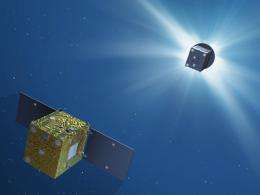
An external coronagraph is due to fly on the formation flying mission Proba-3, revealing normally unseen sections of the solar corona.

(PhysOrg.com) -- All space missions are difficult. Docking a pair of spacecraft is tough but flying multiple satellites together in formation is the real cutting edge.

A new simulator is now allowing mission planners to get to grips with multi-satellite missions to come, starting with ESA’s Proba-3.

Several space agencies are preparing formation-flying missions, but it is hard to overstate the difficulty they face: separate expensive pieces of hardware, each one zipping through space at several kilometres per second, may have to manoeuvre to within metres of each other to achieve their goals.

The relative positions of the satellites must be maintained precisely as they close in: lose control of one part of the formation, even momentarily, and the satellites risk destruction. And orbital dynamics dictate the satellites’ orbits will tend to cross as they circle Earth, another worrying factor for their controllers.

Even so, there are specific tasks only formation flying can do - and a new computing resource should help to achieve them.

The Formation Flying is a suite of software running across linked computers to simulate all aspects of a formation-flying mission. Overseen by ESA’s Software Systems division at the agency’s ESTEC and technology centre in the Netherlands, this new facility can emulate the running of more than a single satellite at once.

“It is a generic simulator for formation-flying missions, whether they include two spacecraft or as many as five or six,” explained Raffaella Franco.

“Simulations are a computer-intensive business anyway, but trying to emulate more than one spacecraft’s onboard computer and software simply will not run on a single computer, not to mention the rest of the satellite and the associated ground systems and inter-satellite links.

“Instead, the Formation Flying Test Bed allows the distribution of software across multiple computers without affecting the user experience.”

The testbed addresses crucial operational factors for formation flying, including mission and vehicle management, guidance navigation, dealing with faults and communicating between satellites.

The facility can also be used for training satellite controllers, preparing new procedures or even as a troubleshooting tool once a mission has made it to orbit.

To help develop the testbed a demonstration model was created based on Proba-3, ESA’s first formation flying mission, due for launch in 2014-15. Proba-3’s two satellites will form the first ‘external coronagraph’ in orbit, with one maintaining an artificial eclipse of the Sun as seen from the other, so that hidden details of the solar corona can be seen.

The testbed was developed by Belgium’s Spacebel, also responsible for Proba-3’s flight software. The project was backed through ESA’s General Support Technology Programme, which aims to mature prototypes into operational hardware.

Explore further: Russia retrieves mice, newts from space

add to favorites email to friend print save as pdf

Related Stories

Proba-3: ESA’s first step towards formation flying

Aug 08, 2006

Proba-3 is the third in ESA’s series of missions for validating developments in space systems while carrying an ‘added value’ user payload which can directly benefit from the innovations under test. Proba-3 ...

Wide-eyed Proba-V will track global vegetation daily

May 04, 2010

(PhysOrg.com) -- The small but powerful camera of ESA's Proba-V mission can fit on a single laboratory table for testing. But when it reaches orbit, this compact sensor will deliver a daily overview of virtually ...

Recommended for you

Russia retrieves mice, newts from space

1 hour ago

A Russian capsule filled with 45 mice and 15 newts along with other small animals returned from a month's mission in orbit on Sunday with data scientists hope will pave the way for a manned flight to Mars.

Mars rover Opportunity examines clay clues in rock

May 18, 2013

(Phys.org) —NASA's senior Mars rover, Opportunity, is driving to a new study area after a dramatic finish to 20 months on "Cape York" with examination of a rock intensely altered by water.

NASA's STEREO detects a CME from the sun

May 17, 2013

On 5:24 a.m. EDT on May 17, 2013, the sun erupted with an Earth-directed coronal mass ejection or CME, a solar phenomenon that can send billions of tons of solar particles into space that can reach Earth ...

Nine-year-old Mars rover passes 40-year-old record

May 17, 2013

While Apollo 17 astronauts Eugene Cernan and Harrison Schmitt visited Earth's moon for three days in December 1972, they drove their mission's Lunar Roving Vehicle 19.3 nautical miles (22.210 statute miles ...

Bright explosion on the Moon

May 17, 2013

For the past 8 years, NASA astronomers have been monitoring the Moon for signs of explosions caused by meteoroids hitting the lunar surface. "Lunar meteor showers" have turned out to be more common than anyone ...

User comments : 0

More news stories

Russia retrieves mice, newts from space

A Russian capsule filled with 45 mice and 15 newts along with other small animals returned from a month's mission in orbit on Sunday with data scientists hope will pave the way for a manned flight to Mars.

Galaxy's Ring of Fire

Johnny Cash may have preferred this galaxy's burning ring of fire to the one he sang about falling into in his popular song. The "starburst ring" seen at center in red and yellow hues is not the product of ...

German energy shift faces headwinds

Tense engineers have their eyes peeled on complex colour-coded diagrams on a wall-sized screen that makes their control room look like the inside of a spaceship.

China police billions spell profit opportunity

Mannequins in riot gear, armoured cars and drones line a police equipment and "anti-terrorism technology" trade fair in Beijing as vendors seek to profit from China's huge internal security budget.

Honeybees trained in Croatia to find land mines

(AP)—Mirjana Filipovic is still haunted by the land mine blast that killed her boyfriend and blew off her left leg while on a fishing trip nearly a decade ago. It happened in a field that was supposedly ...

Internet in 'coma' as Iran election looms

Iran is tightening control of the Internet ahead of next month's presidential election, mindful of violent street protests that social networkers inspired last time around over claims of fraud, users and ...