Divine dione captured by Cassini
Sep 08, 2010
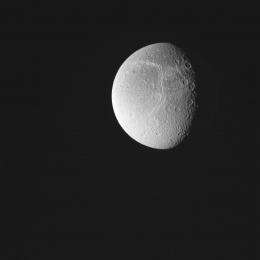
NASA's Cassini spacecraft obtained this image of Saturn's moon Dione on Sept. 3, 2010. The camera was pointing toward Dione at approximately 44,173 kilometers (27,448 miles) away.

Cruising past Saturn's moon Dione this past weekend, NASA's Cassini spacecraft got its best look yet at the north polar region of this small, icy moon and returned stark raw images of the fractured, cratered surface.

The new images also show new views of the long, bright canyon ice walls, which scientists working with NASA's called "wispy terrain" in the early 1980s. These ice walls thread along the surface of the moon's trailing hemisphere and cut across craters.
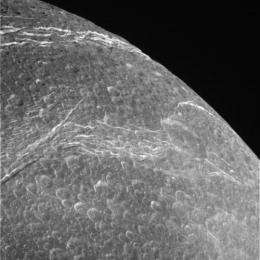
This image was taken on September 03, 2010 and received on Earth September 04, 2010. The camera was pointing toward DIONE at approximately 49,969 kilometers away, and the image was taken using the CL1 and CL2 filters. It has not been validated or calibrated. Image Credit: NASA/JPL/Space Science Institute

The Cassini-Huygens mission is a cooperative project of NASA, the European Space Agency and the Italian Space Agency. JPL, a division of the California Institute of Technology in Pasadena, manages the mission for NASA's Science Mission Directorate, Washington, D.C. The Cassini orbiter and its two onboard cameras were designed, developed and assembled at JPL. The imaging operations center is based at the Space Science Institute in Boulder, Colo.

More raw images of Dione are available at saturn.jpl.nasa.gov/photos/raw/ .

Explore further: Collisions of coronal mass ejections can be super-elastic

More information: More information about the Cassini-Huygens mission is at http://www.nasa.gov/cassini and http://saturn.jpl.nasa.gov

add to favorites email to friend print save as pdf

Related Stories

Image: A Closer Look at Daphnis

Jul 07, 2010

(PhysOrg.com) -- NASA's Cassini spacecraft has captured the closest images of Saturn's moon Daphnis to date.

Cassini's Photo Album From a Season of Icy Moons

Dec 07, 2005

Wrapping up a phenomenally successful year of observing Saturn's icy moons, the Cassini mission is releasing a flood of new views of the moons Enceladus, Dione, Rhea, Hyperion and Iapetus.

Strings of Shadowy Rings Drape Saturn

Sep 17, 2004

Saturn's ring shadows appear wrapped in a harmonious symphony with the planet in this color view from the Cassini spacecraft. Saturn and its rings would nearly fill the space between Earth and the Moon. Ye ...

NASA Salutes Successful Huygens Probe

Jan 15, 2005

NASA Administrator Sean O'Keefe today offered congratulations to the European Space Agency (ESA) on the successful touchdown of its Huygens probe on Saturn's moon Titan. The probe entered Titan's upper atmosphere at ...

Titan's Purple Haze Points to a Fuzzy Past

Aug 02, 2004

Encircled in purple stratospheric haze, Saturn's largest moon, Titan, appears as a softly glowing sphere in this colorized image taken on July 3, 2004, one day after Cassini's first flyby of that moon. Titan ha ...

Recommended for you

Forecast for Titan: Wild weather could be ahead

8 hours ago

(Phys.org) —Saturn's moon Titan might be in for some wild weather as it heads into its spring and summer, if two new models are correct. Scientists think that as the seasons change in Titan's northern hemisphere, ...

SDO observes mid-level solar flare

9 hours ago

UPDATE 16:30 p.m. EDT: The M7-class flare was also associated with a coronal mass ejection or CME, another solar phenomenon that can send billions of tons of particles into space. While this CME was not Ea ...

NASA's IRIS mission readies for a new challenge

18 hours ago

(Phys.org) —The time draws near. NASA is getting ready to launch a new mission, a mission to observe a largely unexplored region of the solar atmosphere that powers its dynamic million-degree outer atmosphere and drives ...

User comments : 0

More news stories

Forecast for Titan: Wild weather could be ahead

(Phys.org) —Saturn's moon Titan might be in for some wild weather as it heads into its spring and summer, if two new models are correct. Scientists think that as the seasons change in Titan's northern hemisphere, ...

Theorists weigh in on where to hunt dark matter

(Phys.org) —Now that it looks like the hunt for the Higgs boson is over, particles of dark matter are at the top of the physics "Most Wanted" list. Dozens of experiments have been searching for them, but ...