Tiny rulers to measure nanoscale structures
Aug 31, 2010
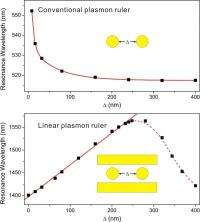
In contrast to a conventional nanoparticle dimer plasmon ruler, this new one shows an approximately linear relationship between the resonance wavelength shifts and nanosphere dimer interparticle separation for a linear plasmon ruler.

With the advent of nanometer-sized machines, there is considerable demand for stable, precise tools to measure absolute distances and distance changes. One way to do this is with a plasmon ruler. In physics jargon, a "plasmon" is the quasiparticle resulting from the quantization of plasma oscillation; it's essentially the collective oscillations of the free electron gas at a metallic surface, often at optical frequencies.

A noble metallic dimer (a molecule that results from combining two entities of the same species) has been used as a plasmon ruler to make absolute distance and distance change measurements.

Physicists at China's Wuhan University discovered that combined with a nanorod dimer could be used to solve the problem of measurement sensitivity. They provide details about their findings in the American Institute of Physics' .

Shao-Ding Liu and Mu-Tian Cheng used a nanostructure as a linear plasmon ruler. Nanospheres were used to modify surface plasmon coupling of a nanorod dimer. They found that the resonance wavelength shift increases approximately linearly with the increasing of a nanosphere's interparticle separations -- resulting in a structure that's useful as a plasmon ruler with homogenous measurement sensitivity.

"A nanoparticle dimer plasmon ruler possesses many advantages because its measurement sensitivity is homogeneous, it can operate in the near-infrared region, and the structure's size and nanorod aspect ratio can be modified freely to get the desired measurement range and sensitivity," notes Liu.

Applications for the linear plasmon ruler extend beyond studies of optical properties of metallic nanostructures to single-molecule microscopy, surface-enhanced Raman spectroscopy, waveguiding and .

Explore further: 3D printing tiny batteries

More information: The article, "Linear plasmon ruler with tunable measurement range and sensitivity" by Shao-Ding Liu and Mu-Tian Cheng will appear in the Journal of Applied Physics. jap.aip.org/resource/1/japiau/v108/i3/p034313_s1

Provided by American Institute of Physics

not rated yet

Related Stories

Visualizing viruses: new research pinpoints tiny invaders

Aug 24, 2010

In the war against infectious disease, identifying the culprit is half the battle. Now, research professor Shaopeng Wang and his colleagues from the Biodesign Institute at Arizona State University, describe a new method for ...

Recommended for you

3D printing tiny batteries

15 hours ago

(Phys.org) —3D printing can now be used to print lithium-ion microbatteries the size of a grain of sand. The printed microbatteries could supply electricity to tiny devices in fields from medicine to communications, ...

World's most powerful microscope ready for research

20 hours ago

(Phys.org) —The world's most powerful microscope, which resides in a specially constructed room at the University of Victoria, has now been fully assembled and tested, and has a lineup of scientists and businesses eager ...

Future looks bright for carbon nanotube solar cells

20 hours ago

(Phys.org) —In an approach that could challenge silicon as the predominant photovoltaic cell material, University of Wisconsin-Madison materials engineers have developed an inexpensive solar cell that exploits ...

A breakthrough in plasmonics

Jun 17, 2013

EPFL scientists have discovered how optical signal transmission can be controlled, paving the way for the integration of plasmonics with conventional electronic circuits.

User comments : 0

More news stories

3D printing tiny batteries

(Phys.org) —3D printing can now be used to print lithium-ion microbatteries the size of a grain of sand. The printed microbatteries could supply electricity to tiny devices in fields from medicine to communications, ...

Future looks bright for carbon nanotube solar cells

(Phys.org) —In an approach that could challenge silicon as the predominant photovoltaic cell material, University of Wisconsin-Madison materials engineers have developed an inexpensive solar cell that exploits ...

Hybrid material as gold-leaf substitute

(Phys.org) —A team of researchers headed by Professor Raffaele Mezzenga has created a hybrid material out of gold and milk proteins that looks like a wafer-thin gold leaf. Thanks to its properties, it could ...

World's most powerful microscope ready for research

(Phys.org) —The world's most powerful microscope, which resides in a specially constructed room at the University of Victoria, has now been fully assembled and tested, and has a lineup of scientists and businesses eager ...

New Zealand emerges as guinea pig for global tech firms

When Google chose New Zealand to unveil secret plans for a balloon-driven wi-fi network last weekend, it cemented the country's reputation as a test bed for global tech companies looking to trial their latest innovations, ...