Sex more likely for female flies with promise of food
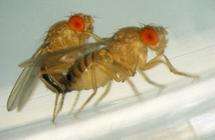
(PhysOrg.com) -- Female fruit flies will have sex more frequently if they think there is more food around, and a new study led by Oxford University has explained how this happens.
There is good reason for female fruit flies to control their sex lives. While they need to mate with sufficient males to fertilise the eggs they produce, there are costs involved. Not only does producing eggs and storing sperm from each mating use up energy, male fruit flies include proteins with their sperm that reduce female lifespan. So there are penalties for females mating too often.
The Oxford-led research found that insulin levels, which respond to food intake, control how often female fruit flies will consent to sex with further males.
Just as in humans, where insulin regulates our blood sugar levels according to meals we’ve just eaten or periods without food, insulin plays a number of similar roles across a large range of species. These include regulating metabolism, stress, fertility and lifespan according to levels of nutrition available. The sexual behaviour of female fruit flies can now be added to this list.
Researchers at the University of Oxford, University College London, the University of East Anglia, and Imperial College London have shown that fruit flies with mutations that inhibit the insulin-responsive pathway will go on after an initial mating to have sex less frequently with other males. They report their findings in the journal Proceedings of the Royal Society B.
‘These fruit flies “think” they are hungry even though there might be plenty of food available,’ explains Dr Stuart Wigby of the Edward Grey Institute at the Department of Zoology, University of Oxford, and lead author of the study.
Similar processes may occur in lots of different animals, including mammals and possibly primates, as insulin-controlled responses to food have been highly conserved in evolution and are found across many species. Associations between food depravation and sexual behaviour have been observed in voles, for example, and connections between poor nutrition and lower human fertility have been reported.
The study also potentially raises issues for some ageing research. Studies of the genetics of ageing in animals such as fruit flies and mice have suggested how it might be possible to extend lifespan. People have begun to consider whether it might be possible to apply these results to human health and development treatments for longer and healthier lives.
In this work, many of the flies with mutations in their insulin pathways - but not all - are long-lived. However, long-life can also be achieved though reduced mating rates and changed sexual behaviour.
Dr Wigby says that research on extending life expectancy needs to control for any differences in behaviour between study groups, as well as the genetics and physiology of the animals so that we do not see spurious results.
‘Understanding the mechanisms of postponed ageing in animal studies is likely to provide major advances the development of clinical interventions to improve healthy lifespan in humans in the future. However, it is important to think beyond simple connections between physiology and lifespan, and consider how any such intervention might affect behaviour as well,’ he says.
More information: Journal: rspb.royalsocietypublishing.org/
Provided by Oxford University


