Project seeks a better image inside Earth
Aug 24, 2010 By Dennis Walikainen
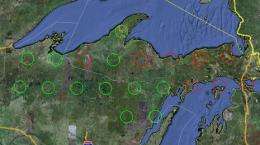
USArray Map of Upper Midwest region, where Michigan Tech will be involved.

(PhysOrg.com) -- Scientists are installing underground seismographs across the US to glean better information about the Earth's interior, and Michigan Tech is deeply into it.

Greg Waite, assistant professor in the geological and mining engineering and sciences department, is part of the USArray project, which seeks to characterize deep earth structure and the source of earthquakes.

“Many people are surprised to know how much we can learn about earthquakes and Earth structure by recording them in the Upper Peninsula,” says Waite. “Signals from moderate to large earthquakes all over the world produce energy that propagates through the deep Earth and can be recorded anywhere.”

The Transportable Array, part of a project called EarthScope, funded by the National Science Foundation, is placing 400 of the broadband seismometers across the US in a grid pattern. The seismometers are sunk seven feet in a 42-inch diameter tank with concrete base. Each recording station also features an eight-foot mast with solar panels, and they'll be used for two years.

The stations have been placed, moving west to east, since 2004 and will eventually occupy about 2,000 locations across the continental United States and Alaska over a 10-to-12-year period.

By analyzing the data from the sensors, scientists can learn about Earth structure and dynamics and the physical processes controlling earthquakes and volcanoes, Waite says. Each station will also record low-frequency pressure in the atmosphere to enhance understanding of atmospheric structure.

Two students from Michigan Tech, Marika Dalton and Andrea Dixon, have spent the summer finding locations for the in the UP and northern Wisconsin.

“It was really interesting, due to the requirements of placing a station,” Dixon said. “The stations had to be away from trees, roads, and marshy areas—which in many cases left very few places to put a station. We got to talk to a lot of people, and they taught us as much about the land and areas they lived in as we told them about the project.”

Michigan Tech’s involvement has just begun and will include helping place stations in the upper Midwest in 2011.

“This project has just started in our region. I’m looking forward to a involving a lot of our students in this work over the next several years,” Waite says.

Explore further: Alaska volcano shoots ash 15,000 feet into the air

add to favorites email to friend print save as pdf

Related Stories

New way to track quakes

Sep 08, 2009

(PhysOrg.com) -- University of Edinburgh scientists have developed a new technique to monitor movements beneath the Earth's surface.

Ancient rock collisions may have formed Western Australia

Mar 30, 2007

A new 3D picture of the geology of Western Australia, captured by measuring seismic waves from deep in the Earth’s crust, has provided evidence that it was created when vast regions of ancient world slammed into each other.

Deadly Mine 'Bump' was Recorded as Seismic Event

Aug 17, 2007

The University of Utah Seismograph Stations recorded a magnitude-1.6 seismic event at the time of a Thursday, Aug. 16 "bump" that killed and injured rescuers at a Utah coal mine where six miners were trapped by an Aug. 6 ...

Recommended for you

Alaska volcano shoots ash 15,000 feet into the air

12 hours ago

(AP)—One of Alaska's most restless volcanoes has shot an ash cloud 15,000 feet into the air in an ongoing eruption that has drawn attention from a nearby community but isn't expected to threaten air traffic.

NASA sees Cyclone Mahasen hit Bangladesh

23 hours ago

NASA's Tropical Rainfall Measuring Mission satellite known as TRMM measured Cyclone Mahasen's rainfall rates from space as it made landfall on May 16. Mahasen has since dissipated over eastern India.

Rapid climate change ruled out ice age trees

May 17, 2013

Short, sharp fluctuations in the Earth's climate throughout the last ice age may have stopped trees from getting a foothold in Europe and northern Asia, scientists say.

Earth's iron core is surprisingly weak, researchers say

May 17, 2013

The massive ball of iron sitting at the center of Earth is not quite as "rock-solid" as has been thought, say two Stanford mineral physicists. By conducting experiments that simulate the immense pressures deep in the planet's ...

User comments : 0

More news stories

Galaxy's Ring of Fire

Johnny Cash may have preferred this galaxy's burning ring of fire to the one he sang about falling into in his popular song. The "starburst ring" seen at center in red and yellow hues is not the product of ...

Alaska volcano shoots ash 15,000 feet into the air

(AP)—One of Alaska's most restless volcanoes has shot an ash cloud 15,000 feet into the air in an ongoing eruption that has drawn attention from a nearby community but isn't expected to threaten air traffic.

Chinese, Indian airlines face EU pollution fines

Eight Chinese and two Indian airlines face fines of up to several million euros for not paying for their greenhouse gas emissions during flights within the bloc, the European Commission said on Friday.

US psychiatry gets makeover in new manual

The latest makeover to a massive psychiatric tome honored by some, reviled by others and even called the "Bible" of mental disorders is being released Saturday with a host of new changes.

Morocco to harness the wind in energy hunt

Morocco is ploughing ahead with a programme to boost wind energy production, particularly in the southern Tarfaya region, where Africa's largest wind farm is set to open in 2014.