'Hot Jupiter' planets unlikely to have moons
Aug 23, 2010 by Lin Edwards report
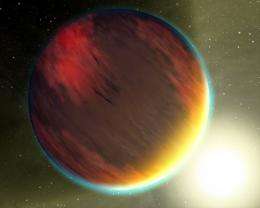
An artist's concept of a "Hot Jupiter" extrasolar planet. Credit: NASA/JPL-Caltech

(PhysOrg.com) -- Planets of the major type so far found outside our solar system are unlikely to have moons, according to new research reported in the August 20 issue of The Astrophysical Journal Letters.

Hundreds of large, hot, Jupiter-class have been discovered orbiting stars outside our . They are called "hot Jupiter" planets because they are large and in close proximity of their stars. As yet no moons have been found circling these planets, but since large planets in our solar system have several moons they ought to exist.

The new research, led by astronomer Fathi Namouni of the Universite de Nice, CNRS, at the Observatoire de la Cote d'Azur in France, determined via that moons orbiting or forming around hot Jupiter planets migrating close in to the star are unlikely to remain because of the large gravitational forces in play between the planet and star. The forces would destroy inner mooons as they smashed into the planet, while outlying moons would be catapulted out of the planet's orbit.

Hot Jupiter planets are believed to form in the outer regions of their solar systems and to migrate inwards towards their star over a period of around 100,000 years. Namouni said that as the planet migrates its sphere of influence over any moons would shrink, making them unstable.

The computer simulation models a that migrates towards its star to become a hot Jupiter. At the beginning of the simulation the planet has four large moons, but all are lost during the migration. The three outermost moons are hurled out into elongated orbits around the star, while the innermost moon smashes into the planet and is destroyed.

Namouni said that if any moons are found around a hot Jupiter they must have been captured later, rather like Neptune's Triton, which is the largest captured moon in the solar system. Triton is believed to have been captured because it orbits in the opposite direction to the other moons of Neptune.

The computer simulations did not take into account possible formation of moons from material orbiting the planet after a moon crashes into the surface.

Astronomers will continue to search for extrasolar moons around hot Jupiter planets because they are the vast majority of planets so far discovered. One way in which they plan to search for them is by observing hot Jupiters as they pass in front of their stars. Any large moons present would alter the timing of transits. Hot Jupiter be unable to support life, but this may not be true of any moons orbiting the planet.

Explore further: South Africa's new radio telescope reveals giant outbursts from binary star system

More information: Fathi Namouni 2010 ApJ 719 L145, doi:10.1088/2041-8205/719/2/L145

Related Stories

Wobbly planets could reveal Earth-like moons

Dec 11, 2008

Moons outside our Solar System with the potential to support life have just become much easier to detect, thanks to research by an astronomer at University College London (UCL).

Avatar's moon Pandora could be real

Dec 17, 2009

In the new blockbuster Avatar, humans visit the habitable - and inhabited - alien moon called Pandora. Life-bearing moons like Pandora or the Star Wars forest moon of Endor are a staple of science fiction. ...

Will Kepler find habitable moons?

Sep 03, 2009

(PhysOrg.com) -- Since the launch of the NASA Kepler Mission earlier this year, astronomers have been keenly awaiting the first detection of an Earth-like planet around another star. Now, in an echo of science ...

Formation of Saturn's ring moons explained

Jun 10, 2010

(PhysOrg.com) -- New computer simulations based on data collected by the Cassini spacecraft mission suggest five of Saturn's moons may have been formed only 10 million years ago, and researchers in France ...

Is The Solar System Unique in The Universe?

Aug 03, 2004

On the evidence to date, our solar system could be fundamentally different from the majority of planetary systems around stars because it formed in a different way. If that is the case, Earth-like planets will be very rar ...

Recommended for you

Galaxy's Ring of Fire

22 hours ago

Johnny Cash may have preferred this galaxy's burning ring of fire to the one he sang about falling into in his popular song. The "starburst ring" seen at center in red and yellow hues is not the product of ...

4C+29.30: Black hole powered jets plow into galaxy

May 15, 2013

(Phys.org) —This composite image of a galaxy illustrates how the intense gravity of a supermassive black hole can be tapped to generate immense power. The image contains X-ray data from NASA's Chandra X-ray ...

A space-time magnifying glass

May 15, 2013

(Phys.org) —Bright arcs are smeared around the heart of galaxy cluster Abell S1077 in this image taken by the NASA/ESA Hubble space telescope. The arcs are stretched images of distant galaxies distorted ...

User comments : 3

Adjust slider to filter visible comments by rank

Display comments: newest first

Modernmystic
5 / 5 (3) Aug 23, 2010
A few years ago Hot Jupiter's themselves were thought to be all but impossible...
Skeptic_Heretic
not rated yet Aug 23, 2010
A few years ago Hot Jupiter's themselves were thought to be all but impossible...

"Usually when a scientist says 'it's impossible' they're just plain wrong." - Michio Kaku, Physics of the Impossible

kevinrtrs
1 / 5 (3) Sep 29, 2010
Namouni said that if any moons are found around a hot Jupiter they must have been captured later, rather like Neptune's Triton, which is the largest captured moon in the solar system. Triton is believed to have been captured because it orbits in the opposite direction to the other moons of Neptune.

First of all, there's the [highly dubious] assumption that the hot jupiters migrate in towards their star. The computer simulation based on that assumption then shows that any existing moons would be destroyed during that process. However, to cover this assumption in the case where moon[s] ARE found, this quoted other assumption is used.
This neatly sidesteps the totally plausible thought that the planets and their moons originated close to the star in the first place, based on the actual evidence gathered, not assumptions about how it came into existence.

More news stories

Russia retrieves mice, newts from space

A Russian capsule filled with 45 mice and 15 newts along with other small animals returned from a month's mission in orbit on Sunday with data scientists hope will pave the way for a manned flight to Mars.

Galaxy's Ring of Fire

Johnny Cash may have preferred this galaxy's burning ring of fire to the one he sang about falling into in his popular song. The "starburst ring" seen at center in red and yellow hues is not the product of ...

German energy shift faces headwinds

Tense engineers have their eyes peeled on complex colour-coded diagrams on a wall-sized screen that makes their control room look like the inside of a spaceship.

China police billions spell profit opportunity

Mannequins in riot gear, armoured cars and drones line a police equipment and "anti-terrorism technology" trade fair in Beijing as vendors seek to profit from China's huge internal security budget.

Honeybees trained in Croatia to find land mines

(AP)—Mirjana Filipovic is still haunted by the land mine blast that killed her boyfriend and blew off her left leg while on a fishing trip nearly a decade ago. It happened in a field that was supposedly ...

Internet in 'coma' as Iran election looms

Iran is tightening control of the Internet ahead of next month's presidential election, mindful of violent street protests that social networkers inspired last time around over claims of fraud, users and ...