Computer chip that computes probabilities and not logic
August 19, 2010 by John Messina
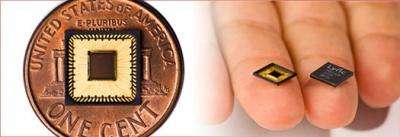
Lyric's Error Correction Chip for Flash Memory. Credit: Lyric Semiconductor
(PhysOrg.com) -- Lyric Semiconductor has unveiled a new type of chip that uses probability inputs and outputs instead of the conventional 1's and 0's used in logic chips today. Crunching probabilities is much more applicable to many computing task performed today rather than binary logic.
Ben Vigoda, CEO and founder of Lyric Semiconductor, has been aggressively working on this technology since 2006 and is partly being funded by the U.S. Defense Advanced Research Projects Agency (DARPA). DARPA is interested in using this technology in defense applications that involves information that is not clear cut and can use probability calculations to come to a conclusion.
Because probability calculations are used in so many products, there are many potential applications. Ben Vigoda stated: "To take one example, Amazon's recommendations to you are based on probability. Any time you buy from them, the fraud check on your credit card is also probability based, and when they e-mail your confirmation, it passes through a spam filter that also uses probability."
Conventional chips have transistors arranged in digital NAND gates which are used to implement digital logic functions using 1's and 0's. In a probability processor transistors are used to build Bayesian NAND gates. Bayesian probability is a field of mathematics named after the eighteenth century English statistician Thomas Bayes.
Lyric Semiconductor plans to have prototypes of their all-purpose probability chips operational within three years. Currently a smaller flash memory error-correcting chip, based on the probability technology, is available for license this week. The company plans on having flash memory chips in portable devices like tablets and smartphones within two years.
More information: Lyric Semiconductor
Via: Technology Review
© 2010 PhysOrg.com
-
From lemons to lemonade: Reaction uses carbon dioxide to make carbon-based semiconductor,
28 comments
-
Every black hole contains a new universe: A physicist presents a solution to present-day cosmic mysteries,
215 comments
-
New silicon memory chip developed,
16 comments
-
Thioridazine kills cancer stem cells in human while avoiding toxic side-effects of conventional cancer treatments,
2 comments
-
SpaceX private rocket blasts off for space station (Update),
41 comments
-
Ideas to mitigate risk of 911 calls being misdirected
15 hours ago
-
Live scribe pen?
May 10, 2012
-
Shallow water flow simulation
May 07, 2012
-
Tablet for taking notes?
May 05, 2012
-
Best fit tablet for me?
May 05, 2012
-
Measure of Informaton
May 04, 2012
- More from Physics Forums - Computing & Technology
More news stories
Beyond oil, can Alaska be tapped as a source for renewable energy?
Alaska has massive hydro, wind, geothermal and other renewable resources, but the state's rural villages are chained to diesel and suffer oppressive energy costs they say threaten their existence. Lawmakers, energy experts ...
Technology / Energy & Green Tech
13 minutes ago |
not rated yet |
0
Computers excel at identifying smiles of frustration (w/ Video)
(Phys.org) -- Researchers at the Massachusetts Institute of Technology (MIT) in the US have trained computers to recognize smiles, and they have turned out to be more adept at recognizing smiles of frustration ...
Researchers successfully test solar desalination system for arid land agriculture
Ben-Gurion University of the Negev (BGU) researchers have created a man-made oasis in the desert with the successful application of a solar-powered desalination system that provides water for irrigation in arid regions. The ...
Technology / Energy & Green Tech
1 hour ago |
not rated yet |
1
HyperSolar shows dirty water no barrier to power world
(Phys.org) -- The Santa Barbara, California, company, HyperSolar, is set to transparently share the ups and downs of its research experiences toward the companys ultimate vision, successfully producing ...
Solar plane ends first leg of intercontinental bid
The Swiss sun-powered aircraft Solar Impulse landed safely in Madrid early Friday at the end of the first leg of its attempt at an intercontinental flight without using a drop of fuel.
Technology / Energy & Green Tech
8 hours ago |
5 / 5 (1) |
1
First study to suggest that the immune system may protect against Alzheimer's changes in humans
Recent work in mice suggested that the immune system is involved in removing beta-amyloid, the main Alzheimer's-causing substance in the brain. Researchers have now shown for the first time that this may apply in humans.
Inherited DNA change explains overactive leukemia gene
A small inherited change in DNA is largely responsible for overactivating a gene linked to poor treatment response in people with acute leukemia.
A new invading sea crab reaches the Ebro Delta
Originally endemic to the Atlantic Coast of North America, over the past 30 years Dyspanopeus sayi has been involuntarily introduced in the UK, France, the Netherlands, the Black Sea and the Adriatic Sea. A ...
Phone contact with nurses linked with better outcomes for women with gestational diabetes
Among women with gestational diabetes mellitus, referral to a telephone-based nurse management program was associated with lower risk of high baby birth weight and increased postpartum glucose testing, according to Kaiser ...
Physicians definitively links irritable bowel syndrome and bacteria in gut
An overgrowth of bacteria in the gut has been definitively linked to Irritable Bowel Syndrome in the results of a new Cedars-Sinai study which used cultures from the small intestine. This is the first study to use this "gold ...
Implantable pain disk may help those with cancer
An estimated 3.5 million cancer patients around the globe are in severe pain from their disease, but many get no relief.
Aug 19, 2010
Rank: 5 / 5 (4)
Aug 19, 2010
Rank: 5 / 5 (2)
Aug 19, 2010
Rank: 5 / 5 (1)
Aug 19, 2010
Rank: 5 / 5 (1)
wrong, wrong, wrong, wrong, wrong
It's a different type of processor architecture that's all. It'll still use 0s and 1s. However it may lead to new types of CPU architecture which incorporate a PPU (probability processor unit), however this would assume the design could be optimised so that the inevitable slow down which would occur with the extra gates needed to incorporate such a processor, wouldn't out way the positive effects of having a very minimised design. - Most often in CPU design, less is more - just look at the RISC vs CISC for example.
Also not all (in fact most minimised chips aren't) made up of NAND gates - they are made up of whatever types of gate the engineer thought best to make them up out of!
Aug 19, 2010
Rank: 5 / 5 (1)
Aug 20, 2010
Rank: 5 / 5 (1)
I think the idea is to make them really fast. Your brain predicts objects before fully recognizing them. It will either confirm the prediction, or correct itself, but a significant amount of time is passed between when your brain predicts an object to be something and when it confirms that prediction. Ever stare at something for a long time thinking it's one thing or the other but not completely sure until it clicks? Computers would hang and freeze or give up presented such a task. With this chip it can be done much faster. The military needs it to automate UAVs and all kinds of equipment.
Aug 20, 2010
Rank: 5 / 5 (1)
Aug 20, 2010
Rank: not rated yet
Aug 21, 2010
Rank: not rated yet
Aug 22, 2010
Rank: not rated yet
The article says the probability chips will not use conventional 1's and 0's.
C Sharperner is right when they say it sounds like an analog computer.
Anyone know what the human brain use besides logic and probablities even if it is a really far out theory?
Aug 22, 2010
Rank: not rated yet
Aug 23, 2010
Rank: not rated yet
Granted, we might need a while for quantum computing to really appear
Aug 23, 2010
Rank: not rated yet
Very interesting.
Aug 23, 2010
Rank: not rated yet
A quantum computer uses 0's and 1's, and values in between, or something like that. Eventually, quantum computers will use 0's, 1's and 2's.
Aug 23, 2010
Rank: not rated yet
Unfortunately all lottery picks are equally probable (or improbable depending on how you look at it)
Aug 24, 2010
Rank: not rated yet
Not really. A quantum computer would use superpositions. So a bit would be either 0, 1, or a superposition of both 0 and 1.
Aug 24, 2010
Rank: not rated yet
Yes, but we are both right.
Maybe I should have said a quantum computer uses 0's and 1's and superpositions in between, but I have heard it said other ways.
Aug 24, 2010
Rank: not rated yet
Aug 24, 2010
Rank: not rated yet
I am glad you straigthened that one out.
Thanks.