Broadband network could switch Australian voters
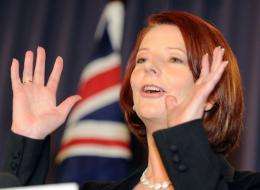
Australian Prime Minister Julia Gillard and her challenger Tony Abbott may not be "tech heads", but their starkly opposed views on a national broadband network are a key battleground in this week's election.
Gillard, who is locked in a tight contest with the conservative Abbott to lead the nation of 22 million, wants to see a 43 billion dollar (39 billion US) superfast fibre optic broadband network rolled out across the vast country.
Abbott, who admits he is no "tech head" or "Bill Gates", wants to scrap the nascent scheme in favour of a 6.3 billion dollar "backbone" for use by competing telecom firms, mainly providing cheaper wireless technology.
It is one of the few points of genuine difference in the election, with Gillard and Abbott both promising to reduce debt, illegal immigration and carbon pollution, but using different means.
Analysts agree Australia's Internet services are poor quality and expensive by international standards, but the National Broadband Network (NBN), which Gillard's Labor party says is vital for the economy, is a divisive issue.
"There is no other policy that is so different than this one," telecommunications analyst Paul Budde told AFP.
"This has grabbed the popular attention. This clearly indicates that there is more on the horizon than just making telephone calls or accessing the Internet. I think people are starting to grasp that."
The policy is also unusually visionary in an election fought mainly on less ambitious matters, and appears popular among Australian voters.
Research by Nielsen has shown that Australians are among the world's biggest users of social media, outstripping the United States, Japan and Britain.
Gillard says the network will offer more than quick emails and downloads but will transform the way people live and work, enabling users to dodge the daily commute by logging on at home, or consult doctors on the other side of the huge country.
She calls objecting to the scheme, which is being closely watched in the United States after President Barack Obama pledged to put broadband in every home, the "modern-day equivalent of having opposed the railroad back years and years ago".
"When the trains got built, they transformed the way the economy worked, they transformed the way people lived. The NBN will do that," she has said.
The centre-left leader has also hung her health policy on the Internet, promising online consultations to ensure that those living outside major cities do not have to travel long distances to receive medical advice.
"I am absolutely satisfied that the NBN was the right investment for this country's future," Gillard said.
But Abbott's Liberal Party argues you can provide fast Internet access across one of the world's biggest countries "just as well for a lot less".
"I'm certain that spending 43 billion dollars on just one technology is not the way to go," Abbott said at public forum in Brisbane on Wednesday.
Telecommunications analyst David Kennedy said the government was ahead of the curve with the NBN plan, but there was as yet no demand within the general community for the super-high speeds -- one gigabit per second -- it promises.
"At the moment there is no demonstrated demand for these very high speeds," he told AFP. "Most people get the speeds that they want right now.
"The government is betting, and it is a bet to be frank, that mass demand for high bandwidth services is going to rise," Kennedy said.
"If the electorate attaches any importance to this it won't be because they have any existing demand (for high speeds)... it will be other things such as the perception of being forward-looking."
Kennedy said while the fibre architecture was likely to be sound, there was little to suggest it would yield productivity gains for businesses that would justify the proposed expenditure on building the network.
(c) 2010 AFP


