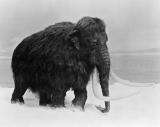
Dwindling green pastures, not hunting, may have killed off the mammoth
Aug 18, 2010
Dwindling green pastures, not hunting, may have killed off the mammoth
Copyright: Natural History Museum

(PhysOrg.com) -- A vast reduction in grasslands may have been the primary cause of the decline of mammals such as the woolly mammoth according to Durham University scientists.

The findings of the new study challenge the theory that human beings were the primary cause of the extinction of mammals through hunting, competition for land and increased pressure on habitats.

The research is part of the most comprehensive study to date of climate and vegetation during and after the height of the last Ice Age, 21,000 years ago. It shows that, over a huge part of the Earth’s surface, there was a massive decline in the productivity and extent of grasslands due to climatic warming and the spread of forests.

These habitat changes made grazing much more difficult for large mammals and dramatically reduced the amount of food available for them. The changes in grassland quality and availability coincided with increases in the distribution and abundance of modern man, Homo sapiens, ensuring a time of wide-scale upheaval for herbivorous mammals and other mammals that preyed on them.

The decrease in productivity and extent of grassland is likely to have been the major contributor to the extinction of many large mammals across most of northern Eurasia and north-western North America by about 11,400 years ago, the onset of the present warm . Although some species held on for several thousand years longer in very limited localities, their fate had effectively been sealed.

Professor Brian Huntley, from the School of Biological and Biomedical Sciences at Durham University, said: “ retreated to northern Siberia 14,000 years ago whereas they had roamed and munched their way across many parts of Europe, including the UK, for most of the previous 100,000 years or more.

“The change from productive grasslands across large areas of northern Eurasia, Alaska and Yukon to less productive tundra-like habitats had a huge effect on many species, particularly on the large herbivores like the woolly rhinoceros and woolly mammoth. Mammoths and other mega-mammals found it increasingly difficult to find food.

“We believe that the loss of food supplies from productive grasslands was the major contributing factor to the extinction of these mega-mammals.”

The Durham University-led team, including scientists from The Natural History Museum, London; Lund University, Sweden, and Bristol University, publish their results in the prestigious scientific journal, Quaternary Science Reviews.

Their study, funded by the Natural Environment Research Council (NERC), looked at ancient pollen records and they also simulated developments in vegetation and habitat linked to climatic change, during and following the last glacial stage.

The team looked at results for a vast geographic area including Eurasia (Europe and northern Asia) and the area of the Bering land bridge that connected Alaska (USA) and the Yukon (Canada) to Siberia, Russia at the height of the last glacial.

They found the post-glacial warming of the planet coupled with an associated change to a moister climate and with increased levels of carbon dioxide in the atmosphere, resulted in the proliferation of trees and the subsequent decline in grasslands - the staple diet and fodder of large herbivores. The decline in herbivores had knock-on effects for other parts of the food chain.

Different theories exist for the cause of the extinction of mega-species like the mammoth. The rise of modern man, Homo sapiens, is cited by some as a potential cause.

Environmental changes have also been considered as a potential factor in the extinction of mega-herbivores such as the mammoth. This new evidence of massive habitat change linked to climatic change is, according to experts, a parable for modern times.

Prof Huntley said: “This was a time of major environmental change and losses of habitat that may have led to the of herbivores and other mega-species that roamed many parts of the planet.

“This is a model for what may happen as a result of rapid climate change over the next century linked to human activity. It is food for thought in these times of global warming and human-induced habitat change. There may well be a lesson to learn.”

The big species today, such as elephants and rhinoceros, are the ones that are most likely to be the first affected by climate change and habitat pressure.

Five species formerly present in Europe, northern Asia, Alaska and Yukon that became globally extinct as grassland diminished:

1. Woolly mammoth
2. Cave lion
3. Giant deer
4. Woolly rhino
5. Cave bear

Five species that survived as grassland diminished:

1. Brown bear
2. Elk (moose)
3. Reindeer
4. Saiga antelope
5. Musk ox

Explore further: Stone Age technological and cultural innovation accelerated by climate, research says

More information: Last glacial vegetation of northern Eurasia. Quaternary Science Reviews, 2010. DOI:10.1016/j.quascirev.2010.05.031

Related Stories

What, or who, killed the last mammoths?

Mar 31, 2010

The last known population of woolly mammoths, roaming a remote Arctic island long after humans invented writing, were wiped out quickly, reports a study released Wednesday.

Scientists reveal family tree of 'super-sized lions'

Mar 31, 2009

(PhysOrg.com) -- The giant cats that roamed the British Isles, as well as Europe and North America, as recently as 13,000 years ago were lions rather than giant jaguars or tigers, a team led by Oxford University ...

Steppe change: Mammoths roamed southern Spain

Jul 09, 2009

Remains of woolly mammoths have been found in southern Spain, proving that the chilly grip of the last Ice Age extended farther south than thought, palaeontologists said on Thursday.

Recommended for you

Divers begin Lake Michigan search for Griffin ship

Jun 16, 2013

Divers began opening an underwater pit Saturday at a remote site in northern Lake Michigan that they say could be the resting place of the Griffin, a ship commanded by the 17th century French explorer La ...

Lost medieval city found in Cambodia

Jun 15, 2013

A lost medieval city that thrived on a mist-shrouded Cambodian mountain 1,200 years ago has been discovered by archaeologists using revolutionary airborne laser technology, a report said.

User comments : 12

Adjust slider to filter visible comments by rank

Display comments: newest first

Pyle
3.4 / 5 (5) Aug 18, 2010
This is a model for what may happen as a result of rapid climate change over the next century linked to human activity

Come on. Cave men had too many camp fires and killed the woolly mammoths?
Careless statements like these are why there are so many people doubting the effects of man made global warming.

Hunting the dwindling populations into extinction? Seems probable.

Causing the global climate shift in 15,000BC? Choose your words more wisely.
Shootist
4 / 5 (4) Aug 18, 2010
This is a model for what may happen as a result of rapid climate change over the next century linked to human activity

Come on. Cave men had too many camp fires and killed the woolly mammoths?
Careless statements like these are why there are so many people doubting the effects of man made global warming.

Hunting the dwindling populations into extinction? Seems probable.

Causing the global climate shift in 15,000BC? Choose your words more wisely.


Delete the "human activity" part, as pure bunk (see Dyson). However, I think it is fair to say that rapid, on the scale of years, or decades, climate change has occurred in the past.

The southern coast of England went from deciduous forest to Tundra in less than 100 years (onset of younger Dryas).
Jordian
4 / 5 (6) Aug 18, 2010
I think humans might have had a small impact on population of animals at that time, but the human race was so small in number its hard to imagine our ancestors wiping out that many animals. A large global explanation seems more likely for such a massive die off.
jimology
2.7 / 5 (6) Aug 18, 2010
If it was rapid, how rapid was it. Much of the meat was frozen so quickly that it was later "harvested" for food. Inside the stomachs of many animals was still undigested food. I don't think humans or global warming had anything to do with it.
MacAuley
3 / 5 (2) Aug 18, 2010
These researchers conveniently focus on the Woolly Mammoth, which apparently was adapted to grass rather than trees. However, in North America there was the Columbian Mammoth, which apparently was adapted to eating branches and tree fruit, and also the Mastodon, which was a forest-dwelling animal.

Both the Columbian Mammoth and the Mastodon should have benefitted from the shift from grassland to forest that supposedly doomed the Woolly Mammoth. However, the Mastodon became extinct about 11,000 years ago and the Columbian Mammoth about 9,000 years ago. This is a few thousand years after humans arrived in North America. Just a coincidence?
marjon
1.9 / 5 (9) Aug 18, 2010
"They found the post-glacial warming of the planet coupled with an associated change to a moister climate and with increased levels of carbon dioxide in the atmosphere,"
Why did CO2 increase? Where were the SUVs?
jsa09
3 / 5 (2) Aug 18, 2010
The fact that Australian Mega Fauna went extinct around 50,000 years ago coincident with the arrival of man, North American mega fauna went extinct about 12,000 years coincident with the arrival of man.

I think there are a too many coincidences here.
Ethelred
4.2 / 5 (5) Aug 19, 2010
Much of the meat was frozen so quickly that it was later "harvested" for food.


Nonsense. They are talking about the mammoths dieing off not some rubbish from Creationists.

The mammoths that have found frozen were not found frozen due to a flood. First floods cannot freeze and second there was no such flood.

Ethelred
Ethelred
4 / 5 (4) Aug 19, 2010
I don't get this constant effort to try to pretend that humans weren't the most likely cause of the extinction of the megafauna. For instance in this case they are claiming that humans somehow changed the environment in way we don't usually do. We create GRASSLANDS not forests. We destroy forests. It is just plain weird to claim that it happened the other way in Europe AND North America.

However Mammoths and other large animals DID tear down forests. Killing all the mammoths would have allowed the forests to grow. This can be seen in the European restoration project in the Netherlands where the wild horses have caused meadows to appear where they been gone since the advent of modern man.

http://discoverma...g-nature

Ethelred
ArcainOne
5 / 5 (2) Aug 19, 2010
When I was in college the most accepted explanation was climate change. These things where massive with just one capable of feeding an entire village(and a rather large one at that) possibly for a few days. While man hunting them didn't help I doubt it was the one and only attributer.

However my assumptions on this are that human villages at the time where relatively small, peeking around a few hundred, and the Mega fauna traveled in large herds like the American Buffalo, in the many hundreds to thousands, with a decent birth rate... I am actually quite open to learning other wise.
otto1923
5 / 5 (1) Aug 19, 2010
However Mammoths and other large animals DID tear down forests. Killing all the mammoths would have allowed the forests to grow. This can be seen in the European restoration project in the Netherlands where the wild horses have caused meadows to appear where they been gone since the advent of modern man.
When euro settlers first got to north america they marvelled at the expansive meadows that they found. Not until recently was it realized that indigenes were burning off forests to create grazing for their prey. Buffalo used to exist as far east as new jersey, as pointed out in C. Manns book, 1491.

http://en.wikiped...Columbus

-Fire is also a good way to drive animals into traps and ravines en masse, making it easier to slaughter them wholesale and only consume the choicest parts. Mammoths were also killed for hides and tusks which were used for dwellings.
otto1923
not rated yet Aug 19, 2010
Mammoth bone dwellings:
http://www.elepha...open=Man and elephants

More news stories

The hidden agenda of Obama's opposition

Is the US Tea Party movement a racial backlash against President Obama? A new study by Angie Maxwell from the University of Arkansas, and Wayne Parent from Louisiana State University, assesses whether racial attitudes are ...

Dish won't submit revised bid for Sprint

Satellite TV operator Dish Network Corp. said Tuesday it would not submit a revised bid for Sprint, leaving the path open for the wireless carrier to accept what it already considers a superior offer from Japan's Softbank.

Cape Wind gets $200M investment from Danish fund

The Cape Wind offshore wind project has secured a $200 million investment from a Danish pension fund in what the wind farm's president said Tuesday is a milestone for the long-delayed project.