New information about how Himalayas were formed
Aug 05, 2010 by Denize Springer
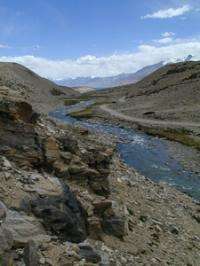
Geologists based their findings on samples taken from eclogites (the dark portions of rock) in northwest India near Tibet.

Evidence of the mineral majorite in Himalayan rocks have overturned scientific theory about the birth of the tallest mountains on Earth.

Geologists have long debated aspects of the collision between Asian and Indian landmasses that formed the Himalayas about 57 million years ago. When the continents collided they closed an ocean between them. The Asian plate forced the Indian plate, still connected to the denser ocean crust, down toward the Earth's mantle in a process called subduction.

Assistant Professor of Geosciences Mary Leech was part of a team of researchers who examined the content of metamorphic rocks that were caught up in the collision between the Asian and Indian landmasses. They examined thin sections of rocks known as eclogites. Collected in the Ladakh region of northwest India near Tibet at an altitude of about 15,000 feet, these samples contained garnet. The garnets held chemical evidence of majorite, which is formed only under extreme pressure at depths of 185 to 200 kilometers. This is more than twice the distance previously accepted (90 kilometers) regarding the depth the Indian crust sank during the continental collision.

"This is the first evidence of the mineral majorite in eclogite rocks found in the Himalayas," Leech said. "Current computer models do not indicate that rocks like those we examined got to such depths and came back up to the surface."

Eclogites are metamorphic rocks formed in subduction zone complexes in mountain belts where two continents come together. Minerals found in the eclogites and formed by extreme pressure give geologists clues to the movement and history of mountain formation. As mountains continue to develop over millions of years, the eclogites move back up to the surface where geologists can easily access samples.

Leech said that the findings will radically change scientific models regarding the age of the mountains and the rate and angle at which the Indian plate continues to collide with the Asian plate while forcing up the Himalayas.

The study, titled "Evidence of former majoritic garnet in Himalayan eclogite points to 200-km-deep subduction of Indian continental crust," was published in the May 2010 issue of the journal Geology. Principal investigator of the study was Anju Pandey of the National Oceanography Centre in Southampton, England.

Leech, a recipient of the prestigious National Science Foundation CAREER grant, studies the chemical aspects of mountain formation and has conducted field work in Himalayan mountain belts as well the Dabie-Sulu belt in eastern China, the Scandinavian Caledonides of Norway, the Urals in Russia and the Kokchetav Massif in Kazakhstan. Her research focuses on eclogite found in these mountain belts.

Explore further: Sea level influenced tropical climate during the last ice age

More information: geology.gsapubs.org/content/38/5.toc

Related Stories

Jade sheds light on Guatemala's geologic history

Jul 27, 2009

The shifting of tectonic plates in Central America has been poorly understood -- until now. New research on jade found along fault lines in Guatemala is helping geologists piece the puzzle of the past 130 million years.

Plate tectonics may take a break

Jan 03, 2008

Plate tectonics, the geologic process responsible for creating the Earth’s continents, mountain ranges, and ocean basins, may be an on-again, off-again affair. Scientists have assumed that the shifting of crustal plates ...

Earth's crust melts easier than previously thought

Mar 18, 2009

A University of Missouri study published in Nature this week has found that the Earth's crust melts easier than previously thought. In the study, researchers measured how well rocks conduct heat at differ ...

Recommended for you

Alaska volcano shoots ash 15,000 feet into the air

May 18, 2013

(AP)—One of Alaska's most restless volcanoes has shot an ash cloud 15,000 feet into the air in an ongoing eruption that has drawn attention from a nearby community but isn't expected to threaten air traffic.

NASA sees Cyclone Mahasen hit Bangladesh

May 17, 2013

NASA's Tropical Rainfall Measuring Mission satellite known as TRMM measured Cyclone Mahasen's rainfall rates from space as it made landfall on May 16. Mahasen has since dissipated over eastern India.

Rapid climate change ruled out ice age trees

May 17, 2013

Short, sharp fluctuations in the Earth's climate throughout the last ice age may have stopped trees from getting a foothold in Europe and northern Asia, scientists say.

User comments : 1

Adjust slider to filter visible comments by rank

Display comments: newest first

Nik_2213
not rated yet Aug 06, 2010
Fascinating ! We may be due a re-run as the Australian plate slams into SE Asia.

More news stories

Mice, gerbils perish in Russia space flight

A number of mice and eight gerbils sent into space in a Russian capsule destined to find out how well organisms can withstand extended flights perished during their journey, scientists said Sunday as the ...

Heat-related deaths in Manhattan projected to rise

Residents of Manhattan will not just sweat harder from rising temperatures in the future, says a new study; many may die. Researchers say deaths linked to warming climate may rise some 20 percent by the 2020s, ...

Honeybees trained in Croatia to find land mines

(AP)—Mirjana Filipovic is still haunted by the land mine blast that killed her boyfriend and blew off her left leg while on a fishing trip nearly a decade ago. It happened in a field that was supposedly ...

Bold action, big money needed to curb Asia floods

Asia's flood-prone megacities should fund major drainage, water recycling and waste reduction projects to stem deluges and secure clean supply for their booming populations, experts said Sunday.