NASA's First Robotic Crew Member To Tweet From Space Station
Aug 02, 2010
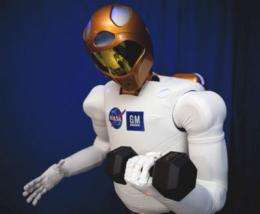
The Robonaut 2.

(PhysOrg.com) -- NASA's Robonaut 2 has no voice but is ready to tell you its story -- in 140 characters or less. The prototype robot will travel to space this fall to give NASA a deeper understanding of human-robotic interaction.

Called R2, the robot has started sending updates about its upcoming mission from its new Twitter account, @AstroRobonaut. With the help of its supporting team, R2 will document its preparations for launch and, eventually, its work aboard the .

"Hello World! My name is Robonaut 2 -- R2 for short," R2 and the team tweeted this week. "Follow my adventures here as I prepare for space!"

Follow R2's updates on Twitter at: www.twitter.com/AstroRobonaut

Reporters are invited to NASA's Johnson Space Center in Houston at 1 p.m. CDT on Aug. 4 to see demonstrations of R2 in action. They can speak with members of the STS-133 space shuttle crew, who will deliver the robot to the station, and engineers who created R2. Interested news media representatives should e-mail Brandi Dean at brandi.k.dean@nasa.gov by noon on Aug. 3.

The public will get the first chance to interview the robot when R2 and its team answer questions submitted via Twitter at 10 a.m. on Aug. 4. followers can submit their questions to R2 in real time by including the hashtag #4R2 in their questions tweeted to @AstroRobonaut.

R2 will be shipped next month from Johnson, where it was created, to NASA's Kennedy Space Center in Florida for final testing and packing. It will launch aboard as part of the STS-133 mission, targeted to lift off in November.

Robonaut 2 was created through a joint project between NASA and General Motors that began in 2007. R2 originally was intended to be an Earth-bound prototype, but engineers wanted to see how it fared in so the robot is being sent to space in Discovery's cargo bay.

R2 is already the most advanced dexterous humanoid robot in existence. Once in space, it will become the first humanoid robot to reach orbit and the first American-built robot at the space station. Over time, as its creators learn more about operating R2 in space, upgrades and modifications could be made that would allow the robot to assist astronauts inside and outside of the station with routine tasks or those too dangerous for humans.

Explore further: NASA head views progress on asteroid lasso mission

add to favorites email to friend print save as pdf

Related Stories

Astronauts 'tweet' from space

May 12, 2009

Astronauts are giving a behind the scenes look at the space shuttle Atlantis's high-risk mission to service the Hubble telescope, thanks to micro-blogging sensation Twitter.

Recommended for you

NASA head views progress on asteroid lasso mission

7 hours ago

Surrounded by engineers, NASA chief Charles Bolden inspected a prototype spacecraft engine that could power an audacious mission to lasso an asteroid and tow it closer to Earth for astronauts to explore.

Ecuador satellite collides with Russian space junk

7 hours ago

A small Ecuadoran satellite collided in orbit with the remains of a Russian rocket, but it is too soon to know how much damage it might have sustained, Quito's space agency said Thursday.

Forecast for Titan: Wild weather could be ahead

May 22, 2013

(Phys.org) —Saturn's moon Titan might be in for some wild weather as it heads into its spring and summer, if two new models are correct. Scientists think that as the seasons change in Titan's northern hemisphere, ...

SDO observes mid-level solar flare

May 22, 2013

UPDATE 16:30 p.m. EDT: The M7-class flare was also associated with a coronal mass ejection or CME, another solar phenomenon that can send billions of tons of particles into space. While this CME was not Ea ...

User comments : 0

More news stories

A hidden population of exotic neutron stars

(Phys.org) —Magnetars – the dense remains of dead stars that erupt sporadically with bursts of high-energy radiation - are some of the most extreme objects known in the Universe. A major campaign using ...

Hubble reveals the ring nebula's true shape

(Phys.org) —The Ring Nebula's distinctive shape makes it a popular illustration for astronomy books. But new observations by NASA's Hubble Space Telescope of the glowing gas shroud around an old, dying, ...

NASA head views progress on asteroid lasso mission

Surrounded by engineers, NASA chief Charles Bolden inspected a prototype spacecraft engine that could power an audacious mission to lasso an asteroid and tow it closer to Earth for astronauts to explore.

Controlling mood through the motions of mitochondria

(Medical Xpress)—Regulating the distribution of power in neurons is done by a system that makes the national electric grid look simple by comparison. Each neuron has several thousand mitochondria confined ...

A quantum simulator for magnetic materials

Physicists understand perfectly well why a fridge magnet sticks to certain metallic surfaces. But there are more exotic forms of magnetism whose properties remain unclear, despite decades of intense research. ...