NASA's ATHLETE Warms Up for High Desert Run (w/ Video)
Jul 30, 2010
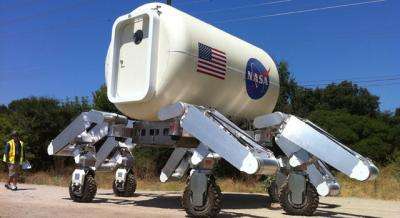
Engineers test the ATHLETE moon rover on one of the long dirt roads found just outside JPL. Image credit: NASA

Engineers from NASA's Jet Propulsion Laboratory are currently putting their All-Terrain, Hex-Limbed, Extra-Terrestrial Explorer (ATHLETE) through a series of long-drive tests on the long, dirt roads found adjacent to JPL.

The JPL grounds do not include an unpaved area of sufficient size for testing such a large robot over a long distance. Some of the dirt roads in the Arroyo Seco (a wash located next to JPL) are wide enough for , and its close proximity to JPL allows the robot to be secured in its hangar between test runs.

The engineers want to test the moon rover's ability to meet a milestone of traveling at least 40 kilometers (25 miles) over 14 days under its own power. The official demonstration is slated to begin in the Arizona high desert next month.

This video is not supported by your browser at this time.

ATHLETE is a 1/2-scale working prototype of a robot under development to transport habitats and other cargo on the surface of the Moon or Mars. The ATHLETE concept is a level cargo deck carried by six wheels, each on the end of a configurable leg. The prototype stands approximately 4.5 meters (15 feet) tall and 4.5 meters (15 ft) wide and weighs about (about 2,300 kilograms (2.5 tons). The moves relatively slowly, with a top speed during traverse of approximately 2 kilometers per hour (1.25 mph).

Explore further: Building a better team—on Mars

More information: For more information about ATHLETE, including photos and video clips, visit: athlete.jpl.nasa.gov/

add to favorites email to friend print save as pdf

Related Stories

Expanding possibilities of lunar exploration

Apr 09, 2010

(PhysOrg.com) -- Computer science professor's software innovations give NASA robotic explorer extra capabilities, without the cost in time or money to develop mechanical components.

Beyond Apollo: Moon Tech Takes a Giant Leap

Apr 09, 2009

The flight computer onboard the Lunar Excursion Module, which landed on the Moon during the Apollo program, had a whopping 4 kilobytes of RAM and a 74 KB "hard drive." In places, the craft's outer skin was ...

Free Spirit Testing Nearing Completion

Jul 31, 2009

Mars rover engineers at JPL are winding down testing of different escape maneuvers using a test rover in a sand box filled with soil to mimic the Martian surface. It is possible that in early August the first ...

Recommended for you

Forecast for Titan: Wild weather could be ahead

15 minutes ago

(Phys.org) —Saturn's moon Titan might be in for some wild weather as it heads into its spring and summer, if two new models are correct. Scientists think that as the seasons change in Titan's northern hemisphere, ...

SDO observes mid-level solar flare

36 minutes ago

UPDATE 16:30 p.m. EDT: The M7-class flare was also associated with a coronal mass ejection or CME, another solar phenomenon that can send billions of tons of particles into space. While this CME was not Ea ...

NASA's IRIS mission readies for a new challenge

9 hours ago

(Phys.org) —The time draws near. NASA is getting ready to launch a new mission, a mission to observe a largely unexplored region of the solar atmosphere that powers its dynamic million-degree outer atmosphere and drives ...

Building a better team—on Mars

May 21, 2013

Sometime in the next quarter-century, NASA plans to send the first humans to Mars, a mission that will push the boundaries of teamwork for a handful of astronauts who will spend as long as three years together ...

User comments : 1

Adjust slider to filter visible comments by rank

Display comments: newest first

Nik_2213
not rated yet Aug 01, 2010
Neat !
I do hope that they plan to try it in a variety of sand-traps...

More news stories

Forecast for Titan: Wild weather could be ahead

(Phys.org) —Saturn's moon Titan might be in for some wild weather as it heads into its spring and summer, if two new models are correct. Scientists think that as the seasons change in Titan's northern hemisphere, ...

SDO observes mid-level solar flare

UPDATE 16:30 p.m. EDT: The M7-class flare was also associated with a coronal mass ejection or CME, another solar phenomenon that can send billions of tons of particles into space. While this CME was not Ea ...

NASA's Landsat satellite looks for a cloud-free view

For decades, Landsat satellites have documented the desiccation of the Aral Sea in Central Asia. Once one of the largest seas in the world, it shrunk to a tenth of its original volume after Russia diverted ...