Fly Eye Paves the Way for Manufacturing Biomimetic Surfaces
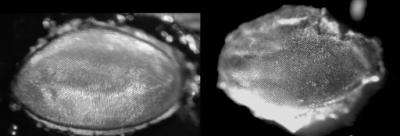
(PhysOrg.com) -- Rows of tiny raised blowfly corneas may be the key to easy manufacturing of biomimetic surfaces, surfaces that mimic the properties of biological tissues, according to a team of Penn State researchers.
"Bioreplication began about 2001 or 2002," said Akhlesh Lakhtakia, Godfrey Binder Professor of Engineering Science and Mechanics. "All the techniques currently available are not conducive to mass replications. In many cases you can make as many replicas as you want, but you need an insect for each replication. This is not good for industrial purposes."
Lakhtakia, working with Drew Patrick Pulsifer, graduate student in engineering science and mechanics; Carlo G. Pantano, distinguished professor of materials science and engineering and director of Penn State's Materials Research Institute; and Raúl José Martín-Palma, professor of applied physics, Universidad Autónomia de Madrid, Spain, developed a method to create macroscale molds or dies that retain nanoscale features.
"We needed an object large enough to manipulate that still had nanoscale features," said Lakhtakia.
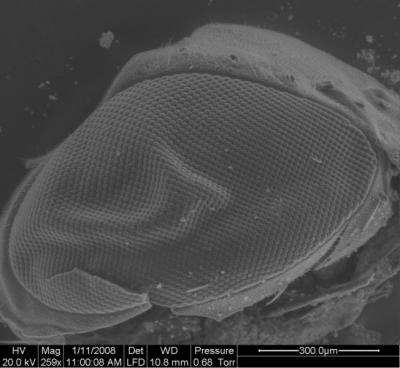
The researchers chose blowfly eyes because they have potential application in the manufacture of solar cells. Blowflies have compound eyes that are roughly hemispherical; but within that half sphere, the surface is covered by macroscale hexagonal eyes with nanoscale features.
"These eyes are perfect for making solar cells because they would collect more sunlight from a larger area rather than just light that falls directly on a flat surface," said Lakhtakia.
However, in order to work in a manufactured product, the surface needs to retain the overall design in sufficient detail.
The researchers fixed the fly corneas on a glass substrate and filled the back of the corneas with polydimethylsiloxane, a silicone-based organic polymer, so that the metal covering they apply would not seep behind the eyes. They then deposited nickel on the surface using a modified form of the conformal-evaporated-film-by-rotation technique. In this technique, the researchers thermally evaporate the material that forms the coating in a vacuum chamber. The object receiving the coating is fixed to a holder and rotated about once every two seconds.
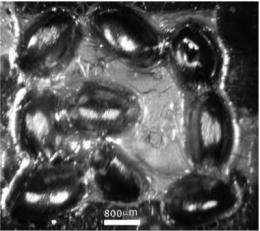
The researchers used arrays of nine blowfly eyes coated with 250 nanometers of nickel. This initial template was then electroformed -- a method of electroplating -- to deposit nickel on the back to create a master template half a millimeter thick. The thickness of the master template can be thicker.
"Polymer replicas produced . . . by casting did faithfully reproduce features of a few micrometers and larger in dimensions," the researchers reported in the online edition of Bioinspiration & Biomimetics.
The master template can be used either as a die to stamp the pattern or as a mold. The intention is to use the master die/mold to produce not only daughter dies/molds, but to tile the templates so that they can imprint large areas. The researchers will probably expand their template to include 30 blowfly corneas.
"One of the nice things about a conformal coating like this is, it becomes nanograined," said Lakhtakia. "The surface of the die becomes very smooth so the polymer will probably not stick."
Many biological surfaces exist that could create manufacture surfaces for a variety of applications. The researchers are currently looking at butterfly wings to understand how the surfaces create colors without pigment.
"Interestingly, the emerald ash borer, an insect that has recently become a problem in Pennsylvania, mates by color," said Lakhtakia. "Would lures made from templates of the ash borer skin attract males?"
More information: The paper, "Mass Fabrication Technique For Polymeric Replicas Of Arrays Of Insect Corneas," Bioinspiration & Biomimetics is found at stacks.iop.org/1748-3190/5/036001
Provided by Pennsylvania State University


