NASA Simulates Space Exploration at Remote Arctic Crater Site
(PhysOrg.com) -- NASA personnel are among a group of international researchers who are in the Canadian Arctic assessing concepts for future planetary exploration as part of the Haughton-Mars Project, or HMP-2010.
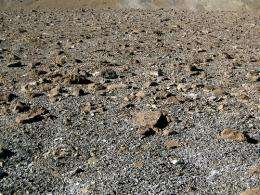
Scientists are using the arid, rocky environment of the Haughton Crater on Devon Island, Canada to simulate conditions that might be encountered by explorers on other planetary bodies. The latest edition of the HMP-2010 began July 19 and includes three weeks of crew and mission control activities and robotic testing.
"Explorers, such as geologists, often find themselves with a set of observations they would have liked to make, or samples they would have liked to take, if only they had been able to stay longer at a site," said Terry Fong, director of the Intelligent Robotics Group at NASA's Ames Research Center in Moffett Field, Calif. "Our work this year is to study how remotely -operated robots, perhaps even vehicles previously used for crew transport, can be used to perform follow-up work."
Using robots for such follow-up work could save astronauts from performing tedious, repetitive or time-consuming activities. Surveying a site could take hundreds to thousands of readings using ground-penetrating radar, spectrometers, or geotechnical instruments. Additionally, robots could make measurements and take pictures that complement or supplement those initially taken by humans.
Mission planners speculate that in the future, there could be substantial amounts of time between crewed missions for robots to perform research work at a range of destinations.
During HMP-2010, NASA will deploy robots developed by the Intelligent Robotics Group at Ames. The robots, known as K10s, are equipped with a variety of instruments including 3-D scanning lidar, color imagers, spectrometers and ground-penetrating radar. The K10s will map systematically above and below ground structures and characterize rocks, soil and landscape of key areas at Haughton Crater.
NASA also will conduct a series of experiments designed to examine how future surface systems, such as crew rovers, might be repositioned robotically from one location to a new rendezvous location with astronauts.
"Poor lighting and low resolution of satellite imagery can make a planned route look very simple from above," said Matt Leonard, deputy manager of the Lunar Surface Systems Project (LSS) at NASA's Johnson Space Center in Houston. "But once we are on the ground, we can see obstacles we couldn't before that make the route unexpectedly challenging. We will study how to use ground robots to scout alternative safe routes, categorize hard-to-detect obstacles and examine how best to prepare for venturing into unknown terrain."
In addition to working around unexpected roadblocks during future planetary convoys, the LSS experiment team will study how a robot on a set route with a fixed schedule can conduct science tasks, such as taking samples or gathering images. The team will work with a K10 robot and HMP's MARS-1 Humvee Rover field exploration vehicle to simulate a large planetary crew rover equipped with science instruments.
The activities in Canada support both the Moon and Mars Analog Mission Activities Program in the Science Mission Directorate and the Exploration Technology Development Program in the Exploration Systems Mission Directorate at NASA Headquarters in Washington.
The Haughton-Mars Project is an international, multidisciplinary field research project focused on the scientific study of the crater and surrounding terrain on Devon Island. The site's polar desert setting, geological features and microbiology make the crater a good site for moon and Mars analog studies. HMP-2010 is managed by the Mars Institute in Moffett Field, Calif., in collaboration with the SETI Institute in Mountain View, Calif.
Provided by JPL/NASA


