Arctic studies show dire effect of ocean acidity
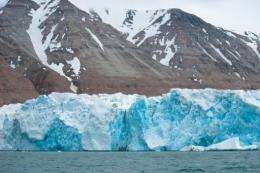
The icy Arctic waters around Norway's archipelago of Svalbard may seem pristine and clear, but like the rest of the world's oceans they are facing the threat of growing acidity.
Oceans have always absorbed part of the carbon dioxide, or CO2, present in the air, which in turn makes them acid. But with CO2 levels soaring, the scientific community is getting worried about acidification harming marine life.
Off the coast of Ny-Aalesund, a tiny coal mine village turned scientific outpost just 1,200 kilometres (745 miles) from the North Pole, researchers from nine European countries conducted in July an unprecedented effort to analyse the phenomenon.
To do so, they submerged nine tubes, each weighing two tonnes and the height of two double-decker busses, in the icy waters of the remote fjord framed by snow-capped mountains.
They then injected the water-tight tubes, called mesocosms, with CO2, to reproduce sea life under different acidity levels expected from now until 2150 with the aim of studying the potentially disastrous effects of acidification on marine life.
"It's here in the Arctic that the ocean will become corrosive the fastest," Jean-Pierre Gattuso, with France's National Center for Scientific Research, said, explaining why the researchers chose to turn these waters thick with icy slush into a laboratory.
The threat to the world's oceans is not so much the absolute concentration of acidity, but rather the pace at which it is changing, Gattuso explained, pointing out that "cold water swallow up gas faster than hot or temperate water."
Oceans absorb more than a quarter of the CO2 emitted by humans, which in one way is fortunate since this natural absorption mitigates the impact the gas has on the climate.
However the soaring levels of man-made CO2 in the atmosphere are proving devastating to the oceans themselves: since the beginning of the industrial era they have become 30 percent more acidic, reaching an acidity peak not seen in at least 55 million years, scientists say.
And with no sign of CO2 emissions slowing down, ocean acidification will likely keep increasing in the decades to come.
This is especially worrisome since higher acidity levels have been shown to sharply slow calcification in corals, shellfish and other species.
Corals, a source of rich biodiversity that prevents land area from being submerged and draws much-needed tourists to some of the world's poorest corners, might thus have trouble shaping their skeletons, while shellfish could lose their shells.
Ulf Riebesell, a German oceanographer, said not all sea creatures were equal in their ability to adapt to their increasingly acid environment.
"For micro-organisims which have generation times of a few days, adaptation may happen during the next 100 years or so as the ocean continues to acidify to critical levels," explained the researcher from the IFM-Geomar centre, braving glacial winds in a bright yellow padded windbreaker and a woolen hat.
But for organisms with long life spans, like corals, "adaptation is much less likely because they need so many generations to change their genetic set-up," Riebesell said.
Scientists caution the current frantic increase of seawater acidity is already causing serious problems for the pteropod, a sort of sea snail vital for the Arctic food chain.
The tiny, translucent mollusc could end up naked in the near future, unable to shape its shell in an increasingly acid environment, explained Jan Buedenbender, another German researcher from the IFM-Geomar institute.
This could have far-reaching consequences, he warned.
"They're a key species for the Arctic food system because they're feeding on very small particles and on phytoplankton, and they're getting quite big and really big animals like whales and birds and fish can feed on them," he explained.
They are also key because their shell contributes to fighting climate change, since it helps the sea snail sink to the bottom when it dies, dragging down all the CO2 ingested over its short lifespan.
By doing so "they're helping the ocean take up more CO2," Buedenbender said.
There is still a chance to save species like the pteropod, according to Iris Menn, a marine biologist with Greenpeace which shipped the giant test-tubes up to Svalbard.
But there is no easy solution. To make a difference, industrialised countries will have to slash their CO2 emissions by 40 percent by 2020, she said.
"We can't stop the trend anyway. We will have a high level of acidity in the water no matter what," she said.
"But what we can do is stop CO2 emissions, so the effect will be reduced."
(c) 2010 AFP


