For pandas, there is a mountain high enough, there is a valley low enough
Jul 22, 2010
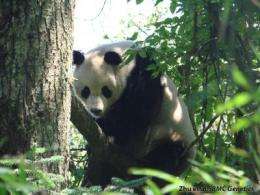
This is a panda. Credit: Zhu et al., BMC Genetics

Genetic analysis of giant pandas has shown that features of their landscape have a profound effect on the movement of genes within their population. Researchers writing in the open access journal BMC Genetics found that physical barriers, such as areas lacking bamboo plants and other forest foliage, can separate giant pandas into isolated genetic groups.

Fuwen Wei, from the Chinese Academy of Sciences, worked with a team of researchers to study giant in the Xiaoxiangling and Daxiangling mountains. He said, "These results suggest that gene flow will be enhanced if the connectivity between the currently fragmented bamboo forests is increased. This may be of importance to conservation efforts as gene flow is one of the most important factors for maintaining within a species and counteracting the negative effects of habitat fragmentation".

The giant panda is one of the most endangered mammals in the world. This is the first study to demonstrate that there is a relationship between landscape features and within their population. Wei and his colleagues recovered 192 fecal samples, which were found to come from 53 unique genotypes. These 'genetic signatures' demonstrated signs of fragmentation within the panda population. The researchers said, "It is vital to reconnect the fragmented habitats and increase the connectivity of bamboo resources within a habitat to restore population viability of the giant panda in these regions".

Explore further: Archaeological genetics: It's not all as old as it at first seems

More information: Landscape features influence gene flow as measured by cost-distance and genetic analyses: a case study for giant pandas in the Daxiangling and Xiaoxiangling mountains, Lifeng Zhu, Xiangjiang Zhan, Tao Meng, Shanning Zhang and Fuwen Wei, BMC Genetics (in press), www.biomedcentral.com/bmcgenet/

Related Stories

Giant pandas endangered by inbreeding: study

Jan 22, 2010

(PhysOrg.com) -- We are all aware that the giant panda is an endangered species. Dutch researchers at the University of Twente’s Faculty of Geo-Information Science and Earth Observation (ITC, The Netherlands) ...

China panda population stable: report

Sep 19, 2009

China's wild panda population has remained stable despite last year's Sichuan earthquake that damaged key areas of the endangered species' habitat, state press said Saturday.

Panda genome resembles dog: Chinese media

Dec 13, 2009

A detailed genome map of the giant panda completed by Chinese scientists has shown that the notoriously shy animal is genetically similar to the dog, state media reported Sunday.

U.S. and China study giant pandas

Nov 27, 2005

A team of Chinese and U.S. zoologists Sunday began a joint study of wild giant pandas in northwest China's Shaanxi Province.

Recommended for you

Lovelorn frogs bag closest crooner

1 hour ago

What lures a lady frog to her lover? Good looks, the sound of his voice, the size of his pad or none of the above? After weighing up their options, female strawberry poison frogs (Oophaga pumilio) bag th ...

Honeybees trained in Croatia to find land mines

18 hours ago

(AP)—Mirjana Filipovic is still haunted by the land mine blast that killed her boyfriend and blew off her left leg while on a fishing trip nearly a decade ago. It happened in a field that was supposedly ...

Front-row seats to climate change

May 17, 2013

By day, insects provide the white noise of the South, but the night belongs to the amphibians. In a typical year, the Southern air hangs heavy from the humidity and the sounds of wildlife.

User comments : 0

More news stories

Lovelorn frogs bag closest crooner

What lures a lady frog to her lover? Good looks, the sound of his voice, the size of his pad or none of the above? After weighing up their options, female strawberry poison frogs (Oophaga pumilio) bag th ...

Engineered microbes grow in the dark

Scientists at the University of California, Davis have engineered a strain of photosynthetic cyanobacteria to grow without the need for light. They report their findings today at the 113th General Meeting of the American ...

Why we need to put the fish back into fisheries

Overfishing has reduced fish populations and biodiversity across much of the world's oceans. In response, fisheries are increasingly reliant on a handful of highly valuable shellfish. However, new research by the University ...

Honeybees trained in Croatia to find land mines

(AP)—Mirjana Filipovic is still haunted by the land mine blast that killed her boyfriend and blew off her left leg while on a fishing trip nearly a decade ago. It happened in a field that was supposedly ...

Blame your parents for bunion woes

A novel study reports that white men and women of European descent inherit common foot disorders, such as bunions (hallux valgus) and lesser toe deformities, including hammer or claw toe. Findings from the Framingham Foot ...