Wacky weather could squeeze Florida's citrus season
Jul 21, 2010
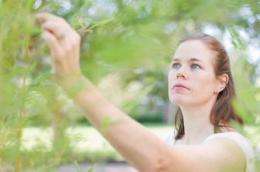
Assistant Professor Betsy Von Holle suggests that subtropical crops such as oranges that depend on mild winters and springs could get squeezed out of Florida. Credit: UCF/Jason Greene

Citrus growers, beware. Florida winters are getting more extreme, causing plants to flower later and potentially shrinking the growing seasons for some of the state's most vital crops.

If a recent trend continues, more frequent freezes and larger temperature swings between winter and spring, followed by hotter summers, could threaten oranges and other crops, according to a team of University of Central researchers.

"The in Florida has been getting wacky," said Betsy Von Holle, the assistant professor of Biology who led the study. "And that's definitely having an impact beyond simple temperature changes. If the trend continues, it may affect everything from when we start seeing flowers and birds migrating to what foods we can grow."

Von Holle suggests that subtropical crops such as oranges that depend on mild winters and springs could get squeezed out of Florida. The team's findings will be published today, July 21, in , a peer-reviewed journal from the Public Library of Science.

The researchers' work highlights the complexity of a in a warming world and the need for more research on seasonal and regional changes in climate, especially in subtropical areas that have received less scientific attention because they're not warming as quickly.

Research on the impacts of climate change and the reproductive patterns of different species traditionally has focused on the mid- to high latitudes, on average as far north as Calgary in Alberta, Canada. Those areas generally have experienced strong spring warming trends that are linked to earlier flowering times.

The UCF team studied more than 50 years of data on seasonal and regional changes in climate and the flowering times of 70 native and non-native plant species throughout all of Florida's counties.

The researchers found an overall rise in Florida's average annual temperatures. However, unlike past studies, their work took an innovative approach by focusing on a more limited geographic region, allowing for a better understanding of regional trends that differ by season. This limited scope actually permitted the researchers to better understand seasonal variations that are masked by a focus on larger trends, such as annual average temperatures.

"There is a desperate need for more modeling on change to be conducted at the regional level and in tropical and subtropical regions," Von Holle said.

Explore further: Scientists present new insights on climate change and species interactions

add to favorites email to friend print save as pdf

Related Stories

Aphids are sentinels of climate change

Aug 06, 2008

Aphids are emerging as sentinels of climate change, researchers at BBSRC-supported Rothamsted Research have shown. One of the UK's most damaging aphids - the peach-potato aphid (Myzus persicae) - has been found to be flying ...

Arctic spring comes weeks earlier than a decade ago

Jun 18, 2007

In the Earth’s cold and icy far north, the harsh winters are giving way to spring weeks earlier than they did just a decade ago, researchers have reported in the June 19th issue of Current Biology. The finding in the Ar ...

Recommended for you

Drought makes Borneo's trees flower at the same time

4 hours ago

Tropical plants flower at supra-annual irregular intervals. In addition, mass flowering is typical for the tropical forests in Borneo and elsewhere, where hundreds of different plant timber species from the ...

Coccoliths thrive despite ocean acidification

6 hours ago

Ocean acidification is damaging some marine species while others thrive, say scientists. An international team studied the effect of ocean acidification on plankton in the North Sea over the past forty years, ...

Australia set to cull 10,000 wild horses

8 hours ago

A controversial cull of up to 10,000 wild horses in Australia's harsh Outback reportedly began Wednesday in a bid to control the feral animals which officials say are destroying the land.

Encouraging signs for bee biodiversity

15 hours ago

Declines in the biodiversity of pollinating insects and wild plants have slowed in recent years, according to a new study. Researchers led by the University of Leeds and the Naturalis Biodiversity Centre in the Netherlands ...

User comments : 1

Adjust slider to filter visible comments by rank

Display comments: newest first

jerryd
not rated yet Jul 25, 2010
Or we could just be having a cold winter like we use to have more regularly? Just now they are getting more rare so when one happens, it looks worse. Been living here since 58 in Fla.

More news stories

Do songbirds hold key to stuttering?

A tiny Australian songbird may hold the answer to discovering the biological source of stuttering, which affects 3 million Americans and is notoriously difficult to treat.

Coral reefs 'ruled by earthquakes and volcanoes'

(Phys.org) —Titanic forces in the Earth's crust explain why the abundance and richness of corals varies dramatically across the vast expanse of the Indian and Pacific Oceans, a world-first study from the ...