Dutch researchers develop anthrax sensor
Jul 16, 2010

Nanotechnologists at University of Twente's MESA+ research institute have developed a sensor that can detect anthrax spores. The invention is more sensitive and efficient than existing detection methods. The research is being published in the leading scientific journal Angewandte Chemie.

Anthrax - notorious as the powder ingredient in letter-bombs - is an infectious and potentially fatal disease caused by the . This bacterium produces spores - dried bacteria with a hard shell - that can survive long-term in the open air. University of Twente researchers have now designed a sensor that can detect a of the spores and thus determine their presence in a concentration one thousand times lower than the known toxic level.

Techniques for detecting anthrax spores (such as fluorescence and ) already exist, but the UT sensor is much more sensitive and effective than any of them. It can also be reused in subsequent trials.

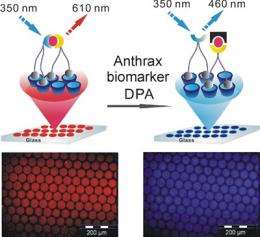
Like other detection techniques, the UT sensor measures the presence of dipicolinic acid (DPA), a substance that accounts for between five and fifteen per cent of the dry weight of the spores. The sensor consists of a glass plate to which DPA-sensitive receptors have been attached. When the receptors are brought into contact with anthrax spores, the DPA binds with them. The concentration of the spores can be calculated with fluorescence spectroscopy, by shining on to the sensor.

DPA-bonded receptors will absorb this light and emit blue light, whereas receptors that have no DPA bonding will emit red light. By measuring the ratio of red to blue light in a sample, it is possible to determine the concentration of anthrax spores. The advantage of the sensor is that it does not need calibrating and is more finely tuned than other current methods. The next step for the researchers is to convert the system into a 'lab-on-a-chip' which will make it possible to measure samples using a fully automatic on-off process.

Explore further: Counting small RNA in disease-causing organisms

add to favorites email to friend print save as pdf

Related Stories

Researchers pave the way for anthrax spore standards

Apr 15, 2008

Researchers from the National Institute of Standards and Technology (NIST) and the U.S. Army Dugway (Utah) Proving Ground have developed reliable methods based on DNA analysis to assess the concentration and ...

Anthrax Detector Developed

Aug 16, 2006

Spores of the dreaded Bacillus anthracis have already been used as a bioweapon against the civilian population. Once inhaled, the anthrax pathogen almost always leads to death if the victims are not treated within 24 to 48 ...

Clemson researchers develop nanotechnology

Oct 03, 2006

Picture a spider web coated with sugar. But instead of luring in unsuspecting creatures, this spider web pulls in deadly anthrax spores, rendering them harmless.

Anthrax cellular entry point uncovered

Jan 25, 2008

The long-sought-after biological “gateway” that anthrax uses to enter healthy cells has been uncovered by microbiologists at the University of Alabama at Birmingham (UAB).

Recommended for you

Counting small RNA in disease-causing organisms

10 hours ago

Small molecules of RNA (tens to hundreds of nucleotides in length) play a key regulatory role in bacteria. Due to their small size, directly measuring the number of small RNA (sRNA) present in a single bacterium ...

Detecting homemade explosives, not toothpaste

Jun 13, 2013

(Phys.org) —Sandia National Laboratories researchers want airports, border checkpoints and others to detect homemade explosives made with hydrogen peroxide without nabbing people whose toothpaste happens ...

Breakthrough allows fast, reliable pathogen identification

Jun 12, 2013

Life-threatening bacterial infections cause tens of thousands of deaths every year in North America. Increasingly, many infections are resistant to first-line antibiotics. Unfortunately, current methods of culturing bacteria ...

Luminous bacterial proteins detect chemicals in water

Jun 12, 2013

While residual medications don't belong in the water, trace metals from industrial process waters handled by the recycling industry are, in contrast, valuable resources. Scientists at the Helmholtz-Zentrum ...

User comments : 0

More news stories

Long distance calls by sugar molecules

All our cells wear a coat of sugar molecules, so-called glycans. ETH Zurich and Empa researchers have now discovered that glycans rearrange water molecules over long distances. This may have an effect on ...

Counting small RNA in disease-causing organisms

Small molecules of RNA (tens to hundreds of nucleotides in length) play a key regulatory role in bacteria. Due to their small size, directly measuring the number of small RNA (sRNA) present in a single bacterium ...

Origins of 'The Hoff' crab revealed (w/ Video)

The history of a new type of crab, nicknamed 'The Hoff' because of its hairy chest, which lives around hydrothermal vents deep beneath the Southern Ocean and Indian Ocean, has been revealed for the first ...